
|
You entered: astronomer
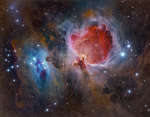 Great Orion Nebulae
13.09.2011
The Great Nebula in Orion, also known as M42, is one of the most famous nebulas in the sky. The star forming region's glowing gas clouds and hot young stars...
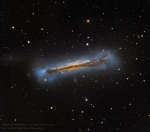 NGC 3682: Sideways Spiral Galaxy
5.09.2018
What do spiral galaxies look like sideways? Featured is a sharp telescopic view of a magnificent edge-on spiral galaxy NGC 3628, a puffy galactic disk divided by dark dust lanes. Of course, this deep galactic portrait puts some astronomers in mind of its popular moniker, The Hamburger Galaxy.
 APOD: 2024 December 1 Б Cosmic Latte: The Average Color of the Universe
1.12.2024
What color is the universe? More precisely, if the entire sky were smeared out, what color would the final mix be? This whimsical question came up when trying to determine what stars are commonplace in nearby galaxies. The answer, depicted here, is a conditionally perceived shade of beige. In computer parlance: #FFF8E7.
 APOD: 2025 September 17 Б Nebulas and Clusters in Sagittarius
17.09.2025
Can you spot famous celestial objects in this image? 18th-century astronomer Charles Messier cataloged only two of them: the bright Lagoon Nebula (M8) at the bottom, and the colorful Trifid Nebula (M20) at the upper right.
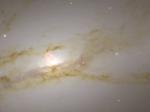 A Bubbling Galaxy Center
12.06.2000
What's happening in the center of this galaxy? Close inspection of the center of NGC 4438, as visible in this recently released representative-color image by the Hubble Space Telescope, reveals an unusual bubble of hot gas, colored in red.
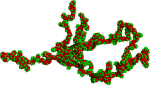 Fractal Interstellar Dust Up Close
9.05.1999
Our universe is a very dusty place. Dust usually shows its presence by blocking out light emitted from stars or nebulae behind it, sometimes creating the illusion of a horse's head or a sombrero hat. But nobody really knows what a typical interstellar dust grain looks like. By
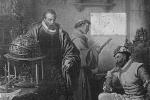 APOD is Two Years Old Today
16.06.1997
The first Astronomy Picture of the Day (APOD) appeared two years ago today. Pictured above is a scene surrounding the creation of an early APOD, depicting the famous astronomer Tycho Brahe demonstrating a celestial globe to Emperor Rudolph II. The image of a possible optical counterpart to a gamma-ray burst appears on the back wall.
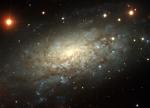 NGC 3621: Far Beyond the Local Group
19.07.2003
Far beyond the local group of galaxies lies NGC 3621, some 22 million light-years away. Found in the serpentine southern constellation Hydra, the loose spiral arms of this gorgeous island universe are loaded with luminous young star clusters and dark dust lanes.
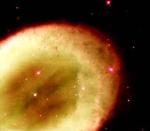 M57: The Ring Nebula
4.05.1998
It looked like a ring on the sky. Hundreds of years ago astronomers noticed a nebula with a most unusual shape. Now known as M57 or NGC 6720, the gas cloud became popularly known as the Ring Nebula.
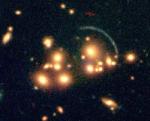 Ring Around the Cluster
4.01.1999
It is difficult to hide a galaxy behind a cluster of galaxies. The closer cluster's gravity will act like a huge lens, pulling images of the distant galaxy around the sides and greatly distorting them. This is just the case observed in the above recently released image from the VLT.
|
January February March April May June July August |
||||||||||||||||||||||||||||||||||||||||||||||||||||||||