
|
You entered: astronomer
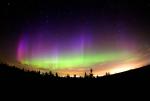 Northern Lights
30.07.2004
While enjoying the spaceweather on a gorgeous summer evening in mid-July, astronomer Philippe Moussette captured this colorful fish-eye lens view looking north from the Observatoire Mont Cosmos, Quebec, Canada, planet Earth. In the foreground, lights along the northern horizon give an orange cast to the low clouds.
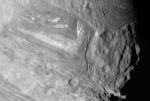 Miranda, Chevron, and Alonso
6.03.1999
Miranda is a bizarre world which surely had a tempestuous past. The innermost of the larger Uranian moons, Miranda is almost 300 miles in diameter and was discovered in 1948 by American planetary astronomer Gerard Kuiper.
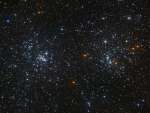 Double Cluster in Perseus
7.12.2007
Skygazers recently following Comet Holmes have probably also chanced across this lovely starfield, not far from the comet on the sky in the constellation Perseus. Some 7,000 light-years away, this pair of open or galactic star clusters is an easy binocular target and is visible to the unaided eye from dark sky areas.
 NGC 3621: Far Beyond the Local Group
19.09.2009
Far beyond the local group of galaxies lies NGC 3621, some 22 million light-years away. Found in the multi-headed southern constellation Hydra, the winding spiral arms of this gorgeous island universe are loaded with luminous young star clusters and dark dust lanes.
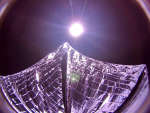 LightSail A
19.06.2015
Hitching a ride to low Earth orbit, LightSail A accomplished a challenging test mission, unfurling its 32 square meter mylar solar sail on June 7. This dramatic image from one of the bread loaf sized spacecraft's fisheye cameras captures the deployed sail glinting in sunlight.
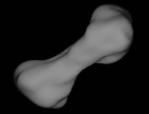 Dog-Bone Shaped Asteroid 216 Kleopatra
10.05.2000
An asteroid the size of New Jersey that orbits the Sun between Mars and Jupiter has been discovered to have an unusual dog-bone shape. Asteroid 216 Kleopatra, recently mapped with Earth-based radar, reflects radio waves so well that astronomers speculate it is composed mostly of metals such as nickel and iron.
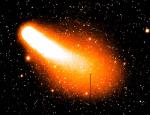 Comet Linear (WM1) Brightens
6.12.2001
A comet bright enough to be seen with binoculars is swooping into southern skies. Comet C/2000 WM1 (LINEAR) continues to brighten and develop tails as it nears its closest approach of the Sun in late January 2002.
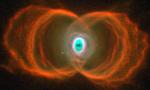 MyCn18: An Hourglass Nebula
14.09.1997
The sands of time are running out for the central star of this hourglass-shaped planetary nebula. With its nuclear fuel exhausted, this brief, spectacular, closing phase of a Sun-like star's life occurs as its outer layers are ejected - its core becoming a cooling, fading white dwarf.
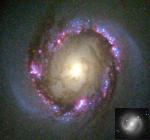 NGC 4314: A Nuclear Starburst Ring
15.06.1998
Is this old galaxy up to new tricks? The barred spiral galaxy NGC 4314 is billions of years old, but its appearance has changed markedly over just the past few millions of years. During that time, a nuclear ring of bright young stars has been evolving.
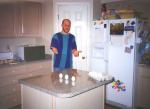 Egging On the Autumnal Equinox
23.09.2003
Today is the autumnal equinox -- should eggs be able to stand on end? This long-standing myth loses much of its mystique after a demonstration that eggs can be made to stand on end during any day of the year. Pictured above, Dr. Phil Plait (Sonoma St.
|
January February March April May June July August |
||||||||||||||||||||||||||||||||||||||||||||||||||||||||