
|
You entered: astronomer
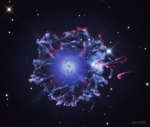 Halo of the Cats Eye
3.08.2022
What created the unusual halo around the Cat's Eye nebula? No one is sure. What is sure is that the Cat's Eye Nebula (NGC 6543) is one of the best known planetary nebulae on the sky.
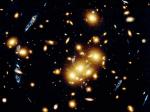 Giant Cluster Bends, Breaks Images
10.06.2001
What are those strange blue objects? Many are images of a single, unusual, beaded, blue, ring-like galaxy which just happens to line-up behind a giant cluster of galaxies. Cluster galaxies here appear yellow and -- together with the cluster's dark matter -- act as a gravitational lens.
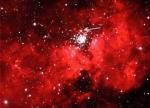 Sher 25: A Pending Supernova
27.10.2001
No supernova has ever been predicted. These dramatic stellar explosions that destroy stars and disperse elements that compose people and planets are not so well understood that astronomers can accurately predict when a star will explode - yet. Perhaps Sher 25 will be the first.
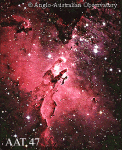 M16: Nebula With Star Cluster
18.01.1997
The photogenic M16 shown above is composed of a young star cluster associated with a spectacular emission nebulae lined with clouds of interstellar dust. The gorgeous spectacle lies toward the galactic center region, some 7,000 light years distant in the constellation Serpens.
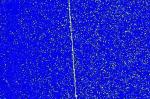 An Anomalous SETI Signal
7.03.2004
No one knows for sure what caused this signal. There is a slight possibility that it just might originate from an extraterrestrial intelligence. The bright colors on the blue background indicate that an anomalous signal was received here on Earth by a radio telescope involved in a Search for Extraterrestrial Intelligence (SETI).
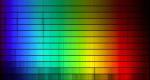 Stellar Spectral Types: OBAFGKM
18.04.2004
Astronomers divide stars into different spectral types. First started in the 1800s, the spectral type was originally meant to classify the strength of hydrogen absorption lines. A few types that best describe the temperature of the star remain in use today.
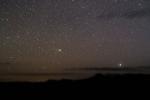 Look West for a NEAT Comet
7.05.2004
On May 5th, while scanning western skies after sunset, astronomer Jimmy Westlake was glad to spot a visitor from the outer solar system, Comet NEAT, with his own eyes. Taken with a normal lens...
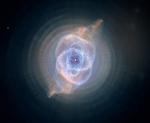 Cat s Eye
10.09.2004
Staring across interstellar space, the alluring Cat's Eye nebula lies three thousand light-years from Earth. A classic planetary nebula, the Cat's Eye (NGC 6543) represents a final, brief yet glorious phase in the life of a sun-like star.
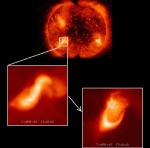 Sigmoids Predict Solar Eruptions
16.03.1999
On the Sun, S marks the spot. Solar explosions have been discovered to explode preferentially from regions marked with this letter. The surface of the quiet Sun is a maze of hot gas and flowing magnetic fields. When two regions of high magnetic field strength approach each other, they typically pass uneventfully.
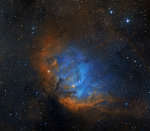 The Tulip in the Swan
20.10.2016
Framing a bright emission region this telescopic view looks out along the plane of our Milky Way Galaxy toward the nebula rich constellation Cygnus the Swan. Popularly called the Tulip Nebula, the glowing cloud of interstellar gas and dust is also found in the 1959 catalog by astronomer Stewart Sharpless as Sh2-101.
|
January February March April May June July August |
||||||||||||||||||||||||||||||||||||||||||||||||||||||||