
|
You entered: astronomer
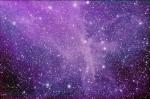 An Unexplored Nebula
29.09.2005
The combined light of the stars of the Milky Way are reflected by this cosmic dust cloud that soars some 300 light-years above the plane of our Galaxy. Dubbed the Angel Nebula by astronomer...
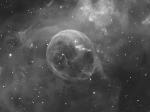 NGC 7635: The Bubble
18.10.2006
What created this huge space bubble? Blown by the wind from a star, this tantalizing, ghostly apparition is cataloged as NGC 7635, but known simply as The Bubble Nebula. Astronomer Eric Mouquet's striking view utilizes a long exposure with hydrogen alpha light to reveal the intricate details of this cosmic bubble and its environment.
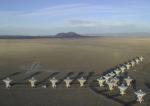 The Very Large Array Turns Twenty
30.05.2000
The most photogenic array of radio telescopes in the world has also been one of the most productive. Each of the 27 radio telescopes in the Very Large Array (VLA) is the size of a house and can be moved on train tracks.
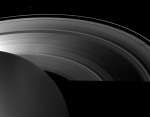 Shadows of Saturn at Equinox
1.09.2009
Unusual shadows and dark rings appeared around Saturn near its equinox last month. At that time -- early August -- Saturn's ring plane pointed directly at the Sun. Visible above, Saturn's moon Tethys casts a shadow visible only on the far right.
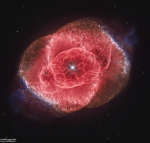 The Cats Eye Nebula from Hubble
30.01.2017
To some, it may look like a cat's eye. The alluring Cat's Eye nebula, however, lies three thousand light-years from Earth across interstellar space. A classic planetary nebula, the Cat's Eye (NGC 6543) represents a final, brief yet glorious phase in the life of a sun-like star.
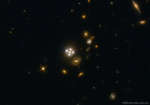 Four Quasar Images Surround a Galaxy Lens
27.02.2017
An odd thing about the group of lights near the center is that four of them are the same distant quasar. This is because the foreground galaxy -- in the center of the quasar images and the featured image -- is acting like a choppy gravitational lens.
 Cosmic Latte: The Average Color of the Universe
27.12.2020
What color is the universe? More precisely, if the entire sky were smeared out, what color would the final mix be? This whimsical question came up when trying to determine what stars are commonplace in nearby galaxies. The answer, depicted above, is a conditionally perceived shade of beige. In computer parlance: #FFF8E7.
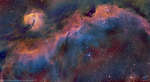 The Seagull Nebula
19.01.2023
A broad expanse of glowing gas and dust presents a bird-like visage to astronomers from planet Earth, suggesting its popular moniker - The Seagull Nebula. Using narrowband image data, this 3-panel mosaic of the cosmic...
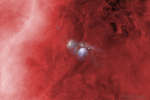 APOD: 2026 January 28 Б M78: Reflecting Blue in a Sea of Red
28.01.2026
In the vast Orion Molecular Cloud complex, several bright blue nebulas are particularly apparent. Pictured here in the center are two of the most prominent reflection nebulas - dust clouds lit by the reflecting light of bright embedded stars. The more famous nebula is M78, in the image center, cataloged over 200 years ago.
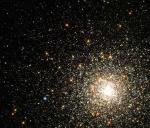 M80: A Dense Globular Cluster
7.07.1999
If our Sun were part of M80, the night sky would glow like a jewel box of bright stars. M80, also known as NGC 6093, is one of about 250 globular clusters that survive in our Galaxy.
|
January February March April May June July August |
||||||||||||||||||||||||||||||||||||||||||||||||||||||||