
|
You entered: astronomer
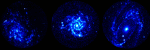 A Spiral Galaxy Gallery
14.03.1998
A progression of beautiful spiral galaxies is illustrated above with three photographs from NASA's Ultraviolet Imaging Telescope (UIT). Flying above the Earth's obscuring layer of atmosphere on the Space Shuttle Columbia during...
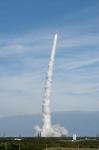 Swift Launches
22.11.2004
Where do gamma ray bursts occur? To help find out, NASA launched the Swift satellite on Saturday, as pictured above. What Swift is designed to do better than any previous satellite is to quickly locate these enigmatic explosions in both sky position and distance.
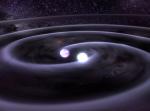 White Dwarf Star Spiral
1.06.2005
About 1,600 light-years away, in a binary star system fondly known as J0806, two dense white dwarf stars orbit each other once every 321 seconds. Interpreting x-ray data from the Chandra Observatory astronomers argue that the stars' already impressively short orbital period is steadily getting shorter as the stars spiral closer together.
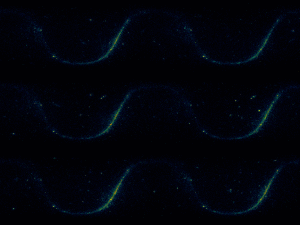 Simulated Gamma ray Sky
31.05.2006
Scheduled for launch in 2007, the Gamma-ray Large Area Space Telescope (GLAST) will explore the Universe in gamma-rays, the most energetic form of light. To get ready, consider this dynamic gamma-ray sky animation - constructed from simulating the first 55 days (seen above at one frame per day) of GLAST observations of cosmic gamma-ray sources.
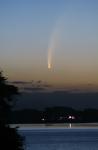 Southern Comet
18.01.2007
After a remarkable performance in the northern hemisphere, the brightest comet in decades is now showing off in the south. Recorded during evening twilight on January 17, this view features the bright coma...
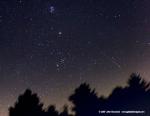 Moonless Perseid Sky
16.08.2007
Last weekend, dark, moonless night skies brought many sightings of Perseid meteors to skygazers all over planet Earth. Early Sunday morning astronomer John Chumack's camera captured this Perseid meteor streak with a flare near the end of its track over Yellow Springs, Ohio.
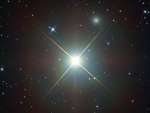 Mirach s Ghost
28.10.2010
As far as ghosts go, Mirach's Ghost isn't really that scary. In fact, Mirach's Ghost is just a faint, fuzzy galaxy, well known to astronomers, that happens to be seen nearly along the line-of-sight to Mirach, a bright star. Centered in this star field, Mirach is also called Beta Andromedae.
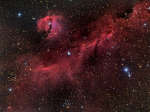 The Seagull Nebula
8.03.2012
A broad expanse of glowing gas and dust presents a bird-like visage to astronomers from planet Earth, suggesting its popular moniker - The Seagull Nebula. This portrait of the cosmic bird covers a 1.6 degree wide swath across the plane of the Milky Way, near the direction of Sirius, alpha star of the constellation Canis Major.
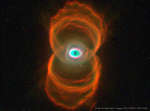 MyCn18: An Hourglass Planetary Nebula
10.05.2015
The sands of time are running out for the central star of this hourglass-shaped planetary nebula. With its nuclear fuel exhausted, this brief, spectacular, closing phase of a Sun-like star's life occurs as its outer layers are ejected - its core becoming a cooling, fading white dwarf.
 IC 2574: Coddington's Nebula
6.02.2025
Grand spiral galaxies often seem to get all the glory, flaunting their young, bright, blue star clusters in beautiful, symmetric spiral arms. But small, irregular galaxies form stars too. In fact dwarf galaxy IC 2574 shows clear evidence of intense star forming activity in its telltale reddish regions of glowing hydrogen gas.
|
January February March April May June July August |
||||||||||||||||||||||||||||||||||||||||||||||||||||||||