
|
You entered: astronomer
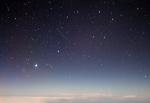 Aurigids from 47 000 Feet
5.09.2007
On September 1, Aurigid meteors filled the sky, in keeping with inovative predictions of an outburst from this historically tentative meteor shower. Astronomers flying at 47,000 feet on a dedicated mission to observer the outburst collected image data for this composite photo of the Aurigids' bright and colorful streaks.
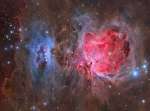 Great Orion Nebulae
23.10.2008
The Great Nebula in Orion, also known as M42, is one of the most famous nebulae in the sky. The star forming region's glowing gas clouds and hot young stars...
 IC 2574: Coddington s Nebula
22.06.2012
Grand spiral galaxies often seem to get all the glory, flaunting their young, bright, blue star clusters in beautiful, symmetric spiral arms. But small, irregular galaxies form stars too. In fact dwarf galaxy IC 2574 shows clear evidence of intense star forming activity in its telltale pinkish regions of glowing hydrogen gas.
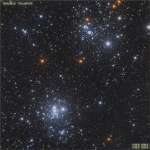 A Double Star Cluster
1.01.2013
Few star clusters are seen to be so close to each other. Some 7,000 light-years away, though, this pair of open or galactic star clusters is an easy binocular target, a lovely starfield in the northern constellation Perseus.
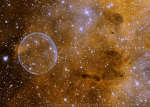 The Soap Bubble Nebula
12.01.2015
Adrift in the rich star fields of the constellation Cygnus, this lovely, symmetric nebula was only recognized a few years ago and does not yet appear in some astronomical catalogs. In fact, amateur astronomer...
 The Great Globular Cluster in Hercules
1.09.2023
In 1716, English astronomer Edmond Halley noted, "This is but a little Patch, but it shows itself to the naked Eye, when the Sky is serene and the Moon absent." Of course...
 M55: Globular Star Cluster
22.09.2000
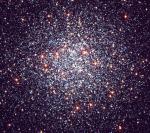
The fifty-fifth entry in Charles Messier's catalog, M55 is a large and lovely globular cluster of around 100,000 stars. Only 20,000 light-years away in the constellation Sagittarius, M55 appears to earth-bound observers to be nearly 2/3 the size of the full moon.
 Coronal Rain, Solar Storm
15.11.2000
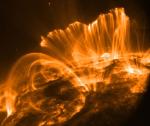
In this picture, the Sun's surface is quite dark. A frame from a movie recorded on November 9th by the orbiting TRACE telescope, it shows coronal loops lofted over a solar active region.
 The Keyhole Nebula in Infrared
13.06.2000
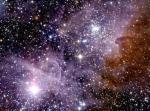
About three million years ago, the stars in the Keyhole Nebula began to form. The above picture of the Keyhole Nebula, also known as the Carina Nebula or NGC 3372, shows in infrared light many facets of this dramatic stellar nursery which lies only 9,000 light-years away.
 Islands in the Photosphere
15.03.2001
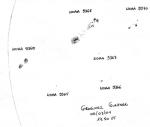
Awash in a sea of plasma and anchored in magnetic fields, sunspots are planet-sized, dark islands in the solar photosphere, the bright surface of the Sun. Before the enlightened(!) age of cameras, solar observers created detailed drawings of sunspots as they changed and progressed across the visible solar disk.
|
January February March April May June July August |
||||||||||||||||||||||||||||||||||||||||||||||||||||||||