
|
You entered: astronomer
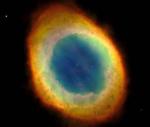 The Ring
7.01.1999
Except for the Rings of Saturn, The Ring Nebula (M57) is probably the most famous celestial band. This planetary nebula's simple, graceful appearance is thought to be due to perspective -- our view from planet Earth looking straight into what is actually a barrel-shaped cloud of gas shrugged off by a dying central star.
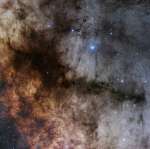 The Pipe Nebula
23.11.2012
East of Antares, dark markings sprawl through crowded star fields toward the center of our Milky Way Galaxy. Cataloged in the early 20th century by astronomer E. E. Barnard, the obscuring interstellar dust clouds include B59, B72, B77 and B78, seen in silhouette against the starry background.
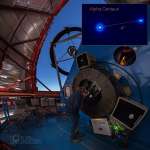 At the Limit of Diffraction
7.05.2015
Did you ever want to just look through the eyepiece of a large telescope in space? If you could, you would see a sharp view that was diffraction limited. Unaffected by atmospheric blurring that...
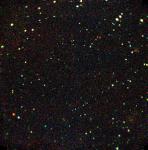 Chandra Deep Field
28.03.2001
Officially the Chandra Deep Field - South, this picture represents the deepest ever x-ray image of the Universe. One million seconds of accumulated exposure time with the orbiting Chandra X-ray Observatory went in to its making.
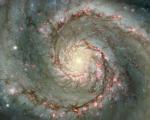 M51: The Whirlpool Galaxy in Dust and Stars
10.04.2001
The Whirlpool Galaxy is a classic spiral galaxy. At only 30 million light years distant and fully 60 thousand light years across, M51, also known as NGC 5194, is one of the brightest and most picturesque galaxies on the sky.
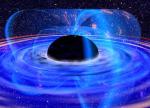 Spinning Black Holes and MCG 6 30 15
29.10.2001
What makes the core of galaxy MCG-6-30-15 so bright? Some astronomers believe the answer is a massive spinning black hole. If so, this would be the first observational indication that it is possible to make a black hole act like a battery -- and tap into its rotational energy.
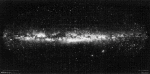 7,000 Stars And The Milky Way
13.02.1996
This panorama view of the sky is really a drawing. It was made in the 1940s under the supervision of astronomer Knut Lundmark at the Lund Observatory in Sweden. To create the picture, draftsmen...
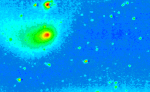 Comet Hale-Bopp Outbound
10.09.1997
Hale-Bopp, the Comet of the Century, is leaving the inner Solar System. Outbound at about 12 miles per second it is presently nearing the main asteroid belt between Mars and Jupiter. This false-color image represents a recent view from low Earth orbit showing the comet surrounded by its shrinking coma against a background of stars.
 T Pyxidis: Recurrent Nova
25.09.1997
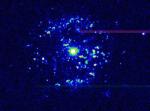
What happens when a thermonuclear blast occurs on the surface of a white dwarf star? Over the years astronomers have watched (at a safe distance ...) as, 6,000 light years from Earth in the southern constellation Pyxis, a binary star known as T Pyxidis repeatedly produces these fearsome explosions.
 Helios Helium
16.05.1998
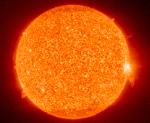
This image of the relatively quiet Sun was made using ultraviolet light emitted by ionized Helium atoms in the Solar chromosphere. Helium was first discovered in the Sun in 1868, its name fittingly derived from from the Greek word Helios, meaning Sun.
|
January February March April May June July August |
||||||||||||||||||||||||||||||||||||||||||||||||||||||||