
|
You entered: astronomer
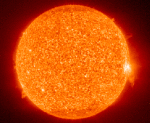 Helios Helium
20.05.1996
Above is an image of the relatively quiet Sun made on May 18 in light emitted by ionized Helium atoms in the Solar chromosphere. Helium was first discovered in the Sun in 1868, its name fittingly derived from from the Greek word Helios, meaning Sun. Credit for the discovery goes to astronomer Joseph Lockyer.
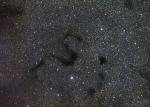 Snake in the Dark
20.06.2003
Dark nebulae snake across a gorgeous expanse of stars in this wide-field view toward the pronounceable constellation Ophiucus and the center of our Milky Way Galaxy. In fact, the central S-shape seen here is well known as the Snake Nebula.
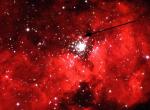 Sher 25: A Pending Supernova?
12.08.1997
No supernova has ever been predicted - yet. These dramatic stellar explosions that destroy stars, that create and disperse the elements that compose people and planets, that light up the night sky, are not so well understood that astronomers can accurately predict when a star will explode - yet. Perhaps Sher 25 will be the first.
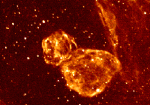 Colliding Supernova Remnants
2.10.1997
When a massive star exhausts its nuclear fuel it explodes. This stellar detonation, a supernova, propels vast amounts of starstuff outwards, initially at millions of miles per hour. For another 100,000 years...
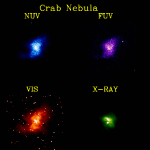 The High Energy Crab Nebula
22.11.1998
This is the mess that is left when a star explodes. The Crab Nebula is so energetic that it glows in every kind of light known. Shown above are images of the Crab Nebula from visible light to the X-ray band.
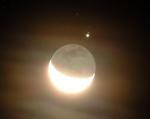 Jupiter and the Moon s Shadowed Horizon
9.12.2004
Early Tuesday morning, December 7th, June Croft thought the southeastern sky above Atmore, Alabama, USA was beautiful. Watching the Moon rise through gossamer clouds, she noted, " ... the crescent Moon looked like it was held in the sky by a star just off its shadowed horizon." What was that star?
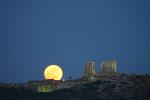 Moonrise, Cape Sounion, Greece
23.06.2005
The Moon was full this month on June 22nd, only a day after the northern hemisphere's summer solstice. Since this solstice marked the northernmost point of the Sun's annual motion through planet...
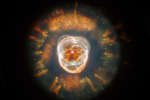 The Eskimo Nebula from Hubble
3.05.2009
In 1787, astronomer William Herschel discovered the Eskimo Nebula. From the ground, NGC 2392 resembles a person's head surrounded by a parka hood. In 2000, the Hubble Space Telescope imaged the Eskimo Nebula. From space, the nebula displays gas clouds so complex they are not fully understood.
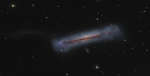 The Tail of the Hamburger Galaxy
8.05.2014
Sharp telescopic views of NGC 3628 show a puffy galactic disk divided by dark dust lanes. Of course, this deep portrait of the magnificent, edge-on spiral galaxy puts some astronomers in mind of its popular moniker, the Hamburger Galaxy.
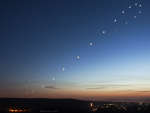 Analemma of the Moon
7.05.2020
An analemma is that figure-8 curve you get when you mark the position of the Sun at the same time each day for one year. But the trick to imaging an analemma of the Moon is to wait bit longer.
|
January February March April May June July August |
||||||||||||||||||||||||||||||||||||||||||||||||||||||||