
|
You entered: astronomer
 Sivan 2 to M31
3.03.2017
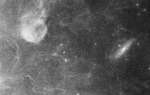
From within the boundaries of the constellation Cassiopeia (left) to Andromeda (right), this telescopic mosaic spans over 10 degrees in planet Earth's skies. The celestial scene is constructed of panels that are part of a high-resolution astronomical survey of the Milky Way in hydrogen-alpha light.
 M13: The Great Globular Cluster in Hercules
12.05.2017
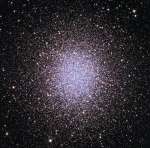
In 1716, English astronomer Edmond Halley noted, "This is but a little Patch, but it shews itself to the naked Eye, when the Sky is serene and the Moon absent." Of course...
 Messier 5
9.05.2019
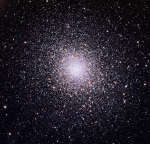
"Beautiful Nebula discovered between the Balance [Libra] & the Serpent [Serpens] ..." begins the description of the 5th entry in 18th century astronomer Charles Messier's famous catalog of nebulae and star clusters. Though it appeared...
 APOD: 2024 January 8 Б The Phases of Venus
8.01.2024
Venus goes through phases. Just like our Moon, Venus can appear as a full circular disk, a thin crescent, or anything in between. Venus, frequently the brightest object in the post-sunset or pre-sunrise sky, appears so small, however, that it usually requires binoculars or a small telescope to clearly see its current phase.
 The Variable Nebula NGC 2261
31.01.2025
The interstellar cloud of dust and gas captured in this sharp telescopic snapshot is seen to change its appearance noticeably over periods as short as a few weeks. Discovered over 200 years ago and cataloged as NGC 2261, bright star R Monocerotis lies at the tip of the fan-shaped nebula.
 Spherical Planetary Nebula Abell 39
23.01.2001
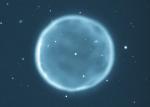
One of the largest spheres in our Galaxy is giving valuable clues about the chemical composition of stars by its very shape. Planetary nebula Abell 39, now six light-years across, was once a sun-like star's outer atmosphere expelled thousands of years ago.
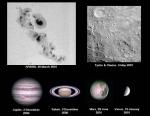 Solar System Web Cam
14.07.2001
Ranging throughout the solar system, these pictures all have something in common. They were taken with an 8 inch diameter telescope, a size popular with amateur astronomy buffs, and slightly modified "web cam" of the type widely used to send images out over the internet.
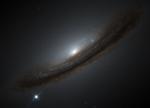 Supernova 1994D and the Unexpected Universe
12.03.2000
Far away, long ago, a star exploded. Supernova 1994D, visible as the bright spot on the lower left, occurred in the outskirts of disk galaxy NGC 4526. Supernova 1994D was not of interest for how different it was, but rather for how similar it was to other supernovae. In fact, the
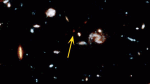 A Distant Galaxy in the Deep Field
28.06.1996
Researchers believe that the faint reddish smudge indicated by the arrow in the image above is a candidate for the most distant known galaxy which may have existed only a few hundred million years after the Big Bang.
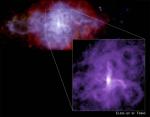 3C58: Pulsar Power
23.12.2004
Light from a star that exploded some ten thousand light-years away first reached our fair planet in the year 1181. Now known as supernova remnant 3C58, the region seen in this false-color image glows in x-rays, powered by a rapidly spinning neutron star or pulsar - the dense remains of the collapsed stellar core.
|
January February |
|||||||||||||||||||||||||||||||||||||||||||||||||