
|
You entered: astronomer
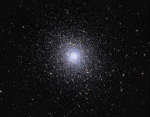 Messier 5
3.08.2012
"Beautiful Nebula discovered between the Balance [Libra] & the Serpent [Serpens] ..." begins the description of the 5th entry in 18th century astronomer Charles Messier's famous catalog of nebulae and star clusters. Though it appeared...
 Runaway Star Alpha Camelopardalis
28.04.2023
Like a ship plowing through cosmic seas, runaway star Alpha Camelopardalis has produced this graceful arcing bow wave or bow shock. The massive supergiant star moves at over 60 kilometers per second through space, compressing the interstellar material in its path.
 The Great Globular Cluster in Hercules
26.09.2024
In 1716, English astronomer Edmond Halley noted, "This is but a little Patch, but it shows itself to the naked Eye, when the Sky is serene and the Moon absent." Of course...
 APOD: 2025 January 6 Б Colliding Spiral Galaxies from Webb and Hubble
6.01.2025
Billions of years from now, only one of these two galaxies will remain. Until then, spiral galaxies NGC 2207 and IC 2163 will slowly pull each other apart, creating tides of matter, sheets of shocked gas, lanes of dark dust, bursts of star formation, and streams of cast-away stars.
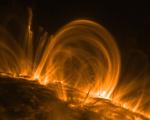 Heating Coronal Loops
28.09.2000
Extending above the photosphere or visible surface of the Sun, the faint, tenuous solar corona can't be easily seen from Earth, but it is measured to be hundreds of times hotter than the photosphere itself. What makes the solar corona so hot?
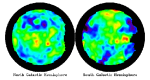 COBE Hotspots: The Oldest Structures Known
6.02.1996
Above are two microwave images of the sky, looking north and south of our galaxy's equator, based on data from NASA's COBE satellite. After computer processing to remove contributions from nearby objects and the effects of the earth's motion, they show "spots".
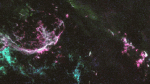 Supernova Remnant: Cooking Elements In The LMC
9.05.1996
Massive stars cook elements in their cores through nuclear fusion. Starting with the light elements of hydrogen and helium, their central temperatures and pressures produce progressively heavier elements, carbon, oxygen, nitrogen, etc. up through iron.
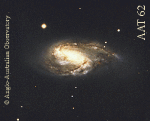 Unusual Spiral Galaxy M66
10.08.1996
Spiral galaxy M66 is largest galaxy in the a group known as the Leo Triplet. M66 is somewhat peculiar because of its asymmetric spiral arms. Usually dense waves of gas, dust, and newly formed stars - called spiral density waves - circle a galactic center and create a symmetric galaxy.
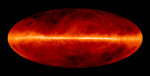 A Sky Full Of Hydrogen
18.12.1996
Interstellar space is filled with extremely tenuous clouds of gas which are mostly Hydrogen. The neutral hydrogen atom (HI in astronomer's shorthand) consists of 1 proton and 1 electron. The proton and electron spin like tops but can have only two orientations; spin axes parallel or anti-parallel.
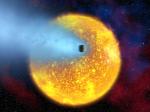 Water Claimed in Evaporating Planet HD 209458b
17.04.2007
Planet HD 209458b is evaporating. It is so close to its parent star that its heated atmosphere is simply expanding away into space. Some astronomers studying this distant planetary system now believe they have detected water vapor among the gases being liberated.
|
January February |
|||||||||||||||||||||||||||||||||||||||||||||||||