
|
You entered: astronomer
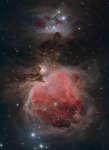 Orion and the Running Man
10.03.2023
Few cosmic vistas excite the imagination like The Great Nebula in Orion. Visible as a faint celestial smudge to the naked-eye, the nearest large star-forming region sprawls across this sharp telescopic image, recorded on a cold January night in dark skies from West Virginia, planet Earth.
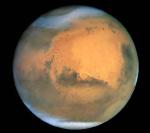 Mars from Earth
18.07.2001
Last month, Mars and Earth were right next to each other in their orbits. Formally called opposition, the event was highlighted by a very bright Mars for skywatchers and a good photo opportunity for the Hubble Space Telescope. Above, Hubble snapped the highest resolution picture of Mars ever obtained from the Earth.
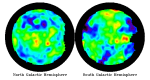 COBE Hotspots:The Oldest Structures Known
9.03.1997
Above are two images of the microwave sky, north and south of our galaxy's equator, based on data from NASA's COsmic Background Explorer (COBE) satellite. After computer processing to remove contributions from nearby objects and the effects of the earth's motion, they show "spots".
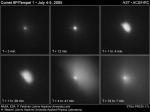 Deep Impact on Comet Tempel 1 from Hubble
18.07.2005
It was a human-made event visible across the Solar System. At the direction of terrestrial scientists, a refrigerator-sized probe from the Deep Impact mission struck Comet Tempel 1 on July 4 at over 35,000 kilometers per hour.
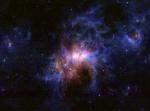 Dusty Environs of Eta Carinae
15.10.2005
Eta Car is a massive star, but it's not as bright as it used to be. Now only easily visible in binoculars or a small telescope, Eta Carinae has a history of spectacular flaring and fading behavior.
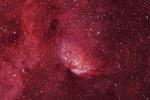 The Tulip in the Swan
24.05.2007
This expansive (1-degree wide) telescopic view looks out along the plane of our Milky Way Galaxy toward the nebula rich constellation Cygnus the Swan. It is centered on a bright hydrogen emission region recorded in the 1959 catalog by astronomer Stewart Sharpless as Sh2-101.
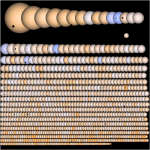 Kepler s Suns and Planets
29.03.2011
Using the prolific planet hunting Kepler spacecraft, astronomers have discovered 1,235 candidate planets orbiting other suns since the Kepler mission's search for Earth-like worlds began in 2009. To find them, Kepler monitors...
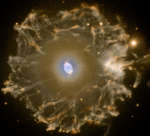 Halo of the Cats Eye
1.06.2014
The Cat's Eye Nebula (NGC 6543) is one of the best known planetary nebulae in the sky. Its haunting symmetries are seen in the very central region of this stunning false-color picture, processed...
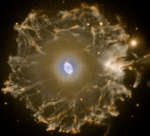 Halo of the Cats Eye
7.06.2020
The Cat's Eye Nebula (NGC 6543) is one of the best known planetary nebulae in the sky. Its haunting symmetries are seen in the very central region of this stunning false-color picture, processed...
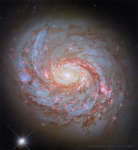 APOD: 2025 December 2 Б M77: Spiral Galaxy with an Active Center
2.12.2025
What's happening in the center of nearby spiral galaxy M77? The face-on galaxy lies a mere 47 million light-years away toward the constellation of the Sea Monster (Cetus). At that estimated distance, this gorgeous island universe is about 100 thousand light-years across.
|
January February March April May June July August |
||||||||||||||||||||||||||||||||||||||||||||||||||||||||