
|
You entered: astronomer
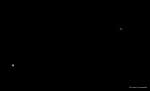 Venus and Jupiter are Far
3.07.2015
On June 30 Venus and Jupiter were actually far apart, but both appeared close in western skies at dusk. Near the culmination of this year's gorgeous conjunction, the two bright evening planets...
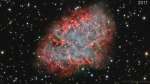 M1: The Incredible Expanding Crab
4.01.2018
The Crab Nebula is cataloged as M1, the first on Charles Messier's famous list of things which are not comets. In fact, the Crab is now known to be a supernova remnant, an expanding cloud of debris from the explosion of a massive star.
800px.preview.jpg) 2023 CX1 Meteor Flash
2023 CX1 Meteor Flash
17.02.2023
While scanning the skies for near earth objects Hungarian astronomer Krisztiцn Sцrneczky first imaged the meter-sized space rock now cataloged as 2023 CX1 on 12 February 2023 at 20:18:07 UTC. That was about 7 hours before it impacted planet Earth's atmosphere.
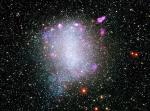 Local Group Galaxy NGC 6822
23.01.2002
Nearby galaxy NGC 6822 is irregular in several ways. First, the galaxy's star distribution merits a formal classification of dwarf irregular, and from our vantage-point the small galaxy appears nearly rectangular. What strikes...
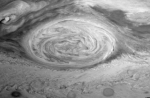 Galileo, Cassini, and the Great Red Spot
2.08.1996
Imagine a hurricane that lasted for 300 years! Jupiter's Great Red Spot indeed seems to be a giant hurricane-like storm system rotating with the Jovian clouds. Observed in 1655 by Italian-French astronomer Jean-Dominique Cassini it is seen here over 300 years later - still going strong - in a mosaic of recent Galileo spacecraft images.
 The Bubble
16.07.2004
Blown by the wind from a star, this tantalizing, ghostly apparition is cataloged as NGC 7635, but known simply as The Bubble Nebula. Astronomer Ken Crawford's striking view combines a long exposure through a hydrogen alpha filter with color images to reveal the intricate details of this cosmic bubble and its environment.
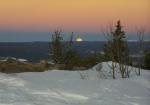 Shadow Set
27.01.2005
A nearly full Moon and planet Earth's shadow set together in this scene captured Monday from snowy Mt. Jelm, home of the Wyoming Infrared Observatory. For early morning risers (and late...
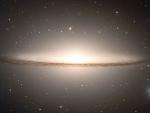 The Sombrero Galaxy from VLT
28.02.2000
Why does the Sombrero Galaxy look like a hat? Reasons include the Sombrero's unusually large and extended central bulge of stars, and dark prominent dust lanes that appear in a disk that we see nearly edge-on. Billions of old stars cause the diffuse glow of the extended central bulge.
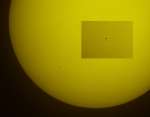 Atlantis and Hubble Side by Side
16.05.2009
On Wednesday, May 13, two, tiny, fast moving spots crossed an otherwise featureless solar disk. Not sunspots though, the dark blemishes were silhouettes of the shuttle orbiter Atlantis and the Hubble Space Telescope side by side.
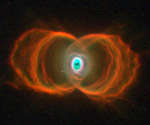 MyCn18: An Hourglass Planetary Nebula
7.08.2011
The sands of time are running out for the central star of this hourglass-shaped planetary nebula. With its nuclear fuel exhausted, this brief, spectacular, closing phase of a Sun-like star's life occurs as its outer layers are ejected - its core becoming a cooling, fading white dwarf.
|
January February March April May June July August |
||||||||||||||||||||||||||||||||||||||||||||||||||||||||