
|
You entered: astronomer
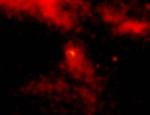 Pulsar Wind in the Vela Nebula
19.07.2001
The Vela pulsar was born 10,000 years ago at the center of a supernova -- an exploding star. In this Chandra Observatory x-ray image, the pulsar still produces a glowing nebula at the heart of the expanding cloud of stellar debris.
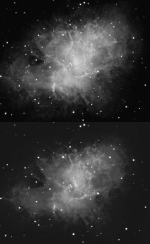 The Incredible Expanding Crab
27.12.2001
The Crab Nebula is cataloged as M1, the first on Charles Messier's famous list of things which are not comets. In fact, the Crab is now known to be a supernova remnant, an expanding cloud of debris from the explosion of a massive star.
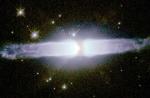 Henize 3 401: An Elongated Planetary Nebula
31.07.2002
How do dying stars eject their outer layers? Stars that create elegant planetary nebulas like Henize 3-401, pictured above, are not unusual, causing speculation that, one day, our own Sun may look like this.
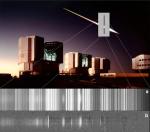 The Spectrum of A Meteor
12.08.2004
Chasing the brief flash of a meteor trail across the sky with a very large telescope is a nearly impossible task. But on May 12, 2002, astronomers got lucky, as a bright meteor chanced across the narrow slit of their spectrograph at the Paranal Observatory.
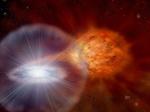 Explosions from White Dwarf Star RS Oph
26.07.2006
Spectacular explosions keep occurring in the binary star system named RS Ophiuchi. Every 20 years or so, the red giant star dumps enough hydrogen gas onto its companion white dwarf star to set off a brilliant thermonuclear explosion on the white dwarf's surface.
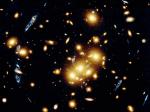 Giant Cluster Bends, Breaks Images
23.04.2000
What are those strange blue objects? Many are images of a single, unusual, beaded, blue, ring-like galaxy which just happens to line-up behind a giant cluster of galaxies. Cluster galaxies here appear yellow and -- together with the cluster's dark matter -- act as a gravitational lens.
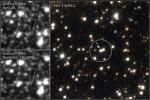 A Big Black Hole Floats By
19.01.2000
A black hole glides silently through space. Is there any way to know it's there? Until last week, all objects that might be black holes in our Galaxy were part of binary star systems.
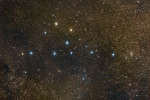 Collinder 399: The Coat Hanger
23.12.2008
Is this coat hanger a star cluster or an asterism? This cosmic hang-up has been debated over much of last century, as astronomers wondered whether this binocular-visible object is really a physically associated open cluster or a chance projection. Chance star projections are known as asterisms, an example of which is the popular Big Dipper.
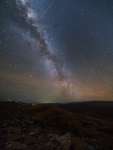 Delphinid Meteor Mystery
15.06.2013
Over a five hour period last Tuesday morning, exposures captured this tantalizing view of meteor streaks and the Milky Way in dark skies above Las Campanas Observatory in Chile. During that time, astronomers...
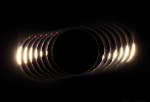 Diamond Rings and Baily s Beads
27.03.2015
Near the March 20 equinox the cold clear sky over Longyearbyen, Norway, planet Earth held an engaging sight, a total eclipse of the Sun. The New Moon's silhouette at stages just before...
|
January February March April May June July August |
||||||||||||||||||||||||||||||||||||||||||||||||||||||||