
|
You entered: eclipse
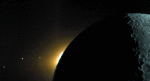 The Ecliptic Plane
21.09.1996
The Plane of the Ecliptic is illustrated in this Clementine star tracker camera image which reveals (from right to left) the Moon lit by Earthshine, the Sun's corona rising over the Moon's dark limb, and the planets Saturn, Mars, and Mercury.
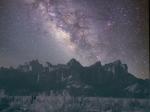 Heaven on Earth
22.02.2004
If sometimes it appears that the entire Milky Way Galaxy is raining down on your head, do not despair. It happens twice a day. As the Sun rises in the East, wonders of the night sky become less bright than the sunlight scattered by our own Earth's atmosphere, and so fade from view.
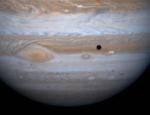 Jupiter, Io, and Shadow
6.12.2002
Pictured above is the innermost of Jupiter's Galilean satellites, Io, superposed in front of the gas giant planet. To the left of Io is a dark spot that is Io's own shadow. A solar eclipse would be seen from within the shadow spot on Jupiter.
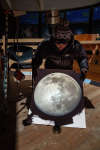 Direct Projection: The Moon in My Hands
27.02.2022
You don't have to look through a telescope to know where it's pointing. Allowing the telescope to project its image onto a large surface can be useful because it dilutes the intense brightness of very bright sources. Such dilution is useful for looking at the Sun, for example during a solar eclipse.
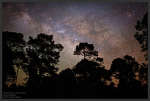 Naked Eye Nova Sagittarii 2015 No 2
24.03.2015
It quickly went from obscurity to one of the brighter stars in Sagittarius -- but it's fading. Named Nova Sagittarii 2015 No. 2, the stellar explosion is the brightest nova visible from Earth in over a year. The featured image was captured four days ago from Ranikhet in the Indian Himalayas.
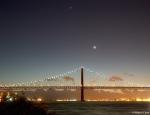 Lisbon Moonset
23.03.2007
Brilliant Venus, a slender crescent Moon, and lights along the Ponte 25 de Abril glow against the western twilight in this lovely moonset scene from Lisbon, Portugal, recorded on March 20. In fact, such...
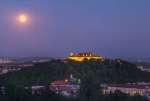 Full Moon over Brno
15.09.2016
After sunset this gorgeous full moon rose over Brno city in the Czech Republic on July 20, 2016. The panoramic image was made during a celebration of the 47th anniversary of the Apollo 11 lunar landing.
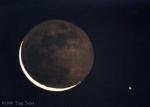 Mercury And The Moon
10.11.1999
Mercury is the closest planet to the Sun and never moves far from our parent star in Earth's sky. Racing around its tight orbit, this well-done world is a little over 1/3 the diameter of Earth and is often lost to our view in the solar glare.
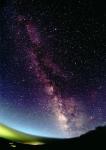 Heaven on Earth
5.11.2000
If sometimes it appears that the entire Milky Way Galaxy is raining down on your head, do not despair. It happens twice a day. As the Sun rises in the East, wonders of the night sky become less bright than the sunlight scattered by our own Earth's atmosphere, and so fade from view.
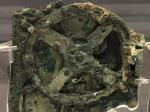 The Antikythera Mechanism
4.12.2006
What is it? It was found at the bottom of the sea aboard an ancient Greek ship. Its seeming complexity has prompted decades of study, although many of its functions remained unknown. Recent X-rays of the device have now confirmed the nature of the Antikythera mechanism, and discovered several surprising functions.
|
January February March April May June July August September |
|||||||||||||||||||||||||||||||||||||||||||||||||