
|
You entered: eclipse
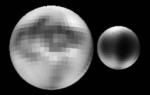 Mysterious Pluto and Charon
8.07.1998
Pluto is the only planet in our Solar System remaining unphotographed by a passing spacecraft. Distant Pluto and its moon Charon therefore remain somewhat mysterious. In addition to direct imaging by the Hubble Space...
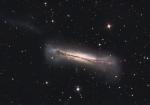 Sideways Galaxy NGC 3628
8.04.2005
Dark dust lanes cutting across the middle of this gorgeous island universe strongly hint that NGC 3628 is a spiral galaxy seen sideways. About 35 million light-years away in the northern springtime constellation...
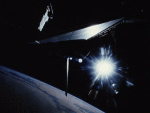 The Equal Night
22.09.1996
Today the Sun crosses the celestial equator heading south -- marking the Autumnal Equinox, the first day of Autumn. Equinox means equal night and with the Sun on the celestial equator, Earthlings will experience 12 hours of daylight and 12 hours of darkness.
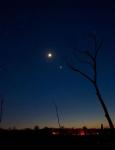 A Western Sky at Twilight
1.05.2004
On April 23rd, the Moon along with planets Saturn, Mars, and Venus (and planet Earth of course ...) were all visible in the west at twilight, captured here from a site near Saylorvillle Lake north of Des Moines, Iowa, USA.
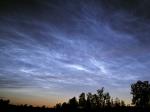 Noctilucent Clouds Over Sweden
18.07.2006
Sometimes it's night on the ground but day in the air. As the Earth rotates to eclipse the Sun, sunset rises up from the ground. Therefore, at sunset on the ground, sunlight still shines on clouds above.
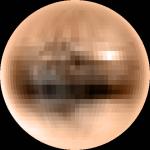 Pluto in True Color
19.03.2001
Pluto is mostly brown. The above picture captures the true colors of Pluto as well as the highest surface resolution so far recovered. No spacecraft has yet visited this most distant planet in our Solar System.
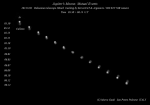 Io and Callisto Mutual Event
25.11.2014
A 24 minute sequence from top to bottom, this intriguing series of telescopic frames tracks the occultation of Io by Callisto, two of Jupiter's Galilean moons, from San Pietro Polesine, Italy, planet Earth. A challenging observational project using a small telescope, the two contrasting Jovian worlds are both slightly larger than Earth's Moon.
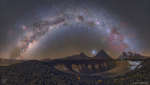 Milky Way over Chilean Volcanoes
21.08.2017
Sometimes, the sky mimics the ground. Taken in 2017 May from the Atacama Desert in Chile, the foreground of the featured image encompasses the dipping edge of the caldera of an extinct volcano. Poetically echoing the dip below is the arch of our Milky Way Galaxy above.
 Medieval Astronomy from Melk Abbey
30.03.2024
Discovered by accident, this manuscript page provides graphical insight to astronomy in medieval times, before the Renaissance and the influence of Nicolaus Copernicus, Tycho de Brahe, Johannes Kepler, and Galileo. The intriguing page is from lecture notes on astronomy compiled by the monk Magister Wolfgang de Styria before the year 1490.
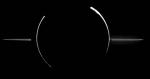 Jupiters Rings Revealed
9.01.2005
Why does Jupiter have rings? Jupiter's rings were discovered in 1979 by the passing Voyager 1 spacecraft, but their origin was a mystery. Data from the Galileo spacecraft that orbited Jupiter from 1995 to 2003 later confirmed that these rings were created by meteoroid impacts on small nearby moons.
|
January February March April May June July August September |
|||||||||||||||||||||||||||||||||||||||||||||||||