
|
You entered: explosion
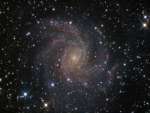 Facing NGC 6946
15.08.2008
From our vantage point in the Milky Way Galaxy, we see NGC 6946 face-on. The big, beautiful spiral galaxy is located just 10 million light-years away, behind a veil of foreground dust and stars in the high and far-off constellation of Cepheus.
 APOD: 2025 April 28 Б Gum 37 and the Southern Tadpoles
28.04.2025
This cosmic skyscape features glowing gas and dark dust clouds alongside the young stars of NGC 3572. A beautiful emission nebula and star cluster, it sails far southern skies within the nautical constellation Carina.
 The Crab that Played with the Planet
10.01.2003
Wandering through the constellation Taurus, Saturn made its closest approach to planet Earth last month, tilting its lovely rings toward appreciative skygazers while rising high in midnight skies. On January 4th and 5th, Saturn...
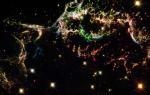 Recycling Cassiopeia A
30.08.2003
For billions of years, massive stars in our Milky Way Galaxy have lived spectacular lives. Collapsing from vast cosmic clouds, their nuclear furnaces ignite and create heavy elements in their cores. After a few million years, the enriched material is blasted back into interstellar space where star formation begins anew.
 The Swirling Core of the Crab Nebula
8.07.2016
At the core of the Crab Nebula lies a city-sized, magnetized neutron star spinning 30 times a second. Known as the Crab Pulsar, it's actually the rightmost of two bright stars, just below a central swirl in this stunning Hubble snapshot of the nebula's core.
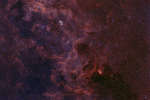 Cosmic Clouds in Cygnus
9.06.2022
These cosmic clouds of gas and dust drift through rich star fields along the plane of our Milky Way Galaxy toward the high flying constellation Cygnus. They're too faint to be seen with the unaided eye though, even on a clear, dark night.
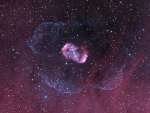 A Halo for NGC 6164
7.05.2009
Beautiful emission nebula NGC 6164 was created by a rare, hot, luminous O-type star, some 40 times as massive as the Sun. Seen at the center of the cosmic cloud, the star is a mere 3 to 4 million years old.
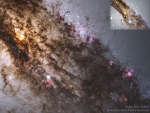 A Supernova through Galaxy Dust
23.02.2016
Telescopes around the world are tracking a bright supernova that occurred in a nearby dusty galaxy. The powerful stellar explosion was first noted earlier this month. The nearby galaxy is the photogenic Centaurus A, visible with binoculars and known for impressive filaments of light-absorbing dust that cross its center.
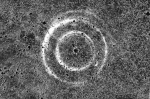 The Expanding Echoes of Supernova 1987A
24.02.2019
Can you find supernova 1987A? It isn't hard -- it occurred at the center of the expanding bullseye pattern. Although this stellar detonation was first seen in 1987, light from SN 1987A continued to bounce off clumps of interstellar dust and be reflected to us even many years later.
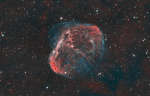 NGC 6888: The Crescent Nebula
17.06.2021
NGC 6888, also known as the Crescent Nebula, is a about 25 light-years across blown by winds from its central, bright, massive star. A triumvirate of astroimagers ( Joe, Glenn, Russell) created this sharp portrait of the cosmic bubble.
|
January February March April May June July August September |
|||||||||||||||||||||||||||||||||||||||||||||||||