
|
You entered: explosion
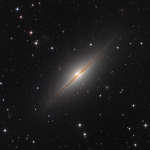 NGC 7814: Little Sombrero with Supernova
22.07.2021
Point your telescope toward the high flying constellation Pegasus and you can find this expanse of Milky Way stars and distant galaxies. NGC 7814 is centered in the pretty field of view that would almost be covered by a full moon.
 APOD: 2025 February 3 Б Wolf Rayet Star 124: Stellar Wind Machine
3.02.2025
Some stars explode in slow motion. Rare, massive Wolf-Rayet stars are so tumultuous and hot that they are slowly disintegrating right before our telescopes. Glowing gas globs each typically over 30 times more massive than the Earth are being expelled by violent stellar winds.
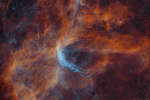 APOD: 2026 May 22 Б The Nebulous Realm of WR 134
22.05.2026
This cosmic snapshot covers a field of view over twice as wide as the full Moon within the boundaries of the high-flying constellation Cygnus. Made using astronomical narrowband filters, the image highlights the bright edge of a ring-like nebula traced by the glow of ionized hydrogen and oxygen gas.
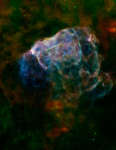 Supernova Remnant Puppis A
12.09.2014
Driven by the explosion of a massive star, supernova remnant Puppis A is blasting into the surrounding interstellar medium about 7,000 light-years away. At that distance, this remarkable false-color exploration of its complex expansion is about 180 light-years wide.
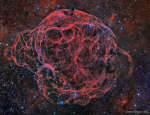 Simeis 147: Supernova Remnant
18.05.2017
It's easy to get lost following intricate filaments in this detailed image of faint supernova remnant Simeis 147. Also cataloged as Sharpless 2-240 it goes by the popular nickname, the Spaghetti Nebula. Seen toward the boundary of the constellations Taurus and Auriga, it covers nearly 3 degrees or 6 full moons on the sky.
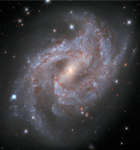 Supernova in NGC 2525
23.10.2020
Big, beautiful, barred spiral galaxy NGC 2525 lies 70 million light-years from the Milky Way. It shines in Earth's night sky within the boundaries of the southern constellation Puppis. About 60,000 light-years...
 APOD: 2024 May 13 Б AR 3664 on a Setting Sun
13.05.2024
It was larger than the Earth. It was so big you could actually see it on the Sun's surface without magnification. It contained powerful and tangled magnetic fields as well as numerous dark sunspots.
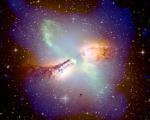 The Colors and Mysteries of Centaurus A
12.08.2002
Why is spiral galaxy Centaurus A in so much turmoil? The above composite image shows different clues to the unusual galaxy's past in different bands of light. In low energy radio waves, shown in red, lobes across the thick swath of dust glow brightly.
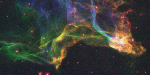 Cygnus Loop Supernova Shockwave
18.07.1995
15,000 years ago a star in the constellation of Cygnus exploded. This picture shows a portion of a shockwave from this supernova explosion still expanding past nearby stars. The collision of this gaseous...
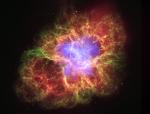 Composite Crab
26.10.2006
The Crab Nebula is cataloged as M1, the first object on Charles Messier's famous list of things which are not comets. In fact, the Crab is now known to be a supernova remnant, expanding debris from the death explosion of a massive star.
|
January February March April May June July August September |
|||||||||||||||||||||||||||||||||||||||||||||||||