
|
You entered: explosion
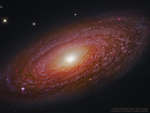 Massive Nearby Spiral Galaxy NGC 2841
24.01.2021
It is one of the more massive galaxies known. A mere 46 million light-years distant, spiral galaxy NGC 2841 can be found in the northern constellation of Ursa Major. This sharp view of the gorgeous island universe shows off a striking yellow nucleus and galactic disk.
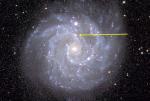 A Gamma Ray Burst Supernova Connection
14.04.2003
New evidence has emerged that a mysterious type of explosion known as a gamma ray burst is indeed connected to a supernova of the type visible in the above image. Two weeks ago, the orbiting HETE satellite detected gamma-ray burst GRB030329.
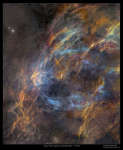 Cygnus Shell Supernova Remnant W63
2.11.2018
The ghost of a long-dead star, the W63 supernova remnant shines like a faint cosmic smoke-ring along the plane of the Milky Way galaxy toward the northern constellation Cygnus the swan. Its wraithlike appearance is traced against the region's rich complex of interstellar clouds and dust by an eerie blue glow.
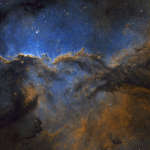 NGC 6188: The Dragons of Ara
7.11.2018
Dark shapes with bright edges winging their way through dusty NGC 6188 are tens of light-years long. The emission nebula is found near the edge of an otherwise dark large molecular cloud in the southern constellation Ara, about 4,000 light-years away.
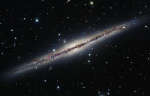 At the Edge of NGC 891
26.05.2012
This sharp cosmic portrait features NGC 891. The spiral galaxy spans about 100 thousand light-years and is seen almost exactly edge-on from our perspective. In fact, about 30 million light-years distant in the constellation Andromeda, NGC 891 looks a lot like our Milky Way.
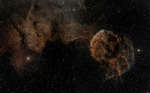 Sharpless 249 and the Jellyfish Nebula
2.12.2014
Normally faint and elusive, the Jellyfish Nebula is caught in this alluring telescopic mosaic. The scene is anchored right and left by two bright stars, Mu and Eta Geminorum, at the foot of the celestial twin while the Jellyfish Nebula is the brighter arcing ridge of emission with dangling tentacles below and right of center.
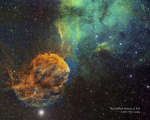 Sharpless 249 and the Jellyfish Nebula
7.01.2017
Normally faint and elusive, the Jellyfish Nebula is caught in this alluring telescopic mosaic. The scene is anchored below by bright star Eta Geminorum, at the foot of the celestial twin, while the Jellyfish Nebula is the brighter arcing ridge of emission with tentacles dangling below and left of center.
 The Nebulous Realm of WR 134
31.05.2024
Made with narrowband filters, this cosmic snapshot covers a field of view over twice as wide as the full Moon within the boundaries of the constellation Cygnus. It highlights the bright edge of a ring-like nebula traced by the glow of ionized hydrogen and oxygen gas.
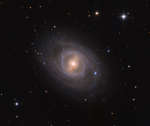 M95 with Supernova
22.03.2012
Barred spiral galaxy M95 is about 75,000 light-years across, comparable in size to our own Milky Way and one of the larger galaxies of the Leo I galaxy group. In fact, it is part of a not quite so famous trio of Leo galaxies with neighbors M96 and M105, about 38 million light-years distant.
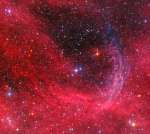 WR 134 Ring Nebula
21.06.2012
Made with narrow and broad band filters, this colorful cosmic snap shot covers a field of view about the size of the full Moon within the boundaries of the constellation Cygnus. It highlights the bright edge of a ring-like nebula traced by the glow of ionized hydrogen and oxygen gas.
|
January February March April May June July August September |
|||||||||||||||||||||||||||||||||||||||||||||||||