
|
You entered: star formation
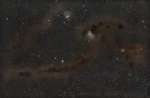 Dark Markings of the Sky
25.04.2009
Based on wide field photographs, American astronomer Edward Emerson Barnard cataloged the dark markings of the sky in the early 20th century. Barnard's markings are dark nebulae, interstellar clouds of obscuring gas and dust.
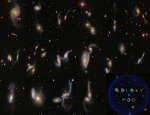 Galaxy Zoo Catalogs the Universe
26.10.2009
You, too, can Zoo. The Galaxy Zoo project has been enabling citizen scientists -- inquisitive people like yourself armed with only a web browser-- to sort through the universe. Specifically, after a brief training session...
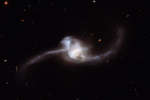 NGC 2623: Galaxy Merger from Hubble
9.11.2009
Where do stars form when galaxies collide? To help find out, astronomers imaged the nearby galaxy merger NGC 2623 in high resolution with the Hubble Space Telescope in 2007. Analysis of this Hubble image...
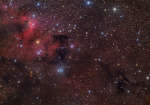 The Light, the Dark, and the Dusty
11.06.2015
This colorful skyscape spans about three full moons (1.5 degrees) across nebula rich starfields along the plane of our Milky Way Galaxy in the royal northern constellation Cepheus. Near the edge of the region...
 Recycling Cassiopeia A
12.07.2002
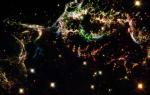
For billions of years, massive stars in our Milky Way Galaxy have lived spectacular lives. Collapsing from vast cosmic clouds, their nuclear furnaces ignite and create heavy elements in their cores. After a few million years, the enriched material is blasted back into interstellar space where star formation begins anew.
 Infrared Portrait of the Large Magellanic Cloud
15.01.2012
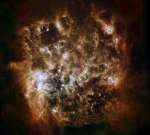
Cosmic dust clouds ripple across this infrared portrait of our Milky Way's satellite galaxy, the Large Magellanic Cloud. In fact, the remarkable composite image from the Herschel Space Observatory and the Spitzer Space Telescope show that dust clouds fill this neighboring dwarf galaxy, much like dust along the plane of the Milky Way itself.
 Infrared Portrait of the Large Magellanic Cloud
23.03.2013
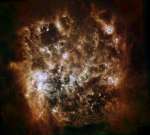
Cosmic dust clouds ripple across this infrared portrait of our Milky Way's satellite galaxy, the Large Magellanic Cloud. In fact, the remarkable composite image from the Herschel Space Observatory and the Spitzer Space Telescope show that dust clouds fill this neighboring dwarf galaxy, much like dust along the plane of the Milky Way itself.
 Infrared Portrait of the Large Magellanic Cloud
14.01.2016
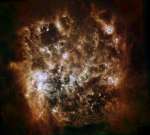
Cosmic dust clouds ripple across this infrared portrait of our Milky Way's satellite galaxy, the Large Magellanic Cloud. In fact, the remarkable composite image from the Herschel Space Observatory and the Spitzer Space Telescope show that dust clouds fill this neighboring dwarf galaxy, much like dust along the plane of the Milky Way itself.
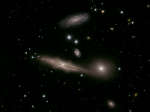 HCG 87: A Small Group of Galaxies
9.08.2015
Sometimes galaxies form groups. For example, our own Milky Way Galaxy is part of the Local Group of Galaxies. Small, compact groups, like Hickson Compact Group 87 (HCG 87) shown above, are interesting partly because they slowly self-destruct.
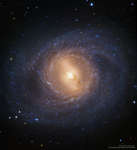 M95: Spiral Galaxy with an Inner Ring
29.05.2019
Why do some spiral galaxies have a ring around the center? First and foremost, M95 is one of the closer examples of a big and beautiful barred spiral galaxy. Visible in the featured combination...
|
January February March April May June July August September October |
|||||||||||||||||||||||||||||||||||||||||||||||||