
|
You entered: light
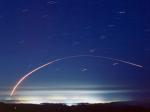 Aura Launch
22.07.2004
In this alluring time exposure, star trails arc across the night sky above Monterey Bay and the lights of Santa Cruz, California, USA. But since the exposure began around 3:01am PDT on July 15 it also records the long trail of a Delta II rocket lofting NASA's Aura spacecraft into Earth orbit.
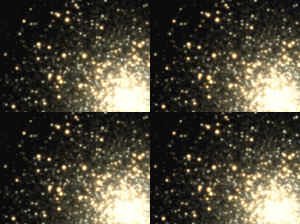 M3: Inconstant Star Cluster
12.10.2004
Star clusters appear constant because photographs of them are frozen in time. In reality, though, cluster stars swarm the center and frequently fluctuate in brightness. Although the time it takes for stars to cross...
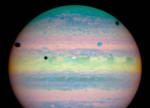 Pastel Planet, Triple Eclipse
11.11.2004
This false-color image of banded gas giant Jupiter shows a triple eclipse in progress on March 28 - a relatively rare event, even for a large planet with many moons. Captured by the Hubble Space...
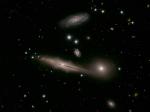 Galaxy Group HCG 87
16.07.2005
Posing for this cosmic family photo are the galaxies of HCG (Hickson Compact Group) 87, about four hundred million light-years distant toward the amphibious constellation Capricornus. The large edge-on spiral near picture center...
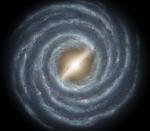 Barred Spiral Milky Way
25.08.2005
A recent survey of stars conducted with the Spitzer Space Telescope is convincing astronomers that our Milky Way Galaxy is not just your ordinary spiral galaxy anymore. Looking out from within the Galaxy's disk, the true structure of the Milky Way is difficult to discern.
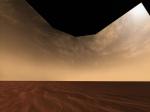 Clouds and Sand on the Horizon of Mars
17.10.2006
If you could stand on Mars -- what might you see? Like the robotic Opportunity rover rolling across the red planet, you might well see vast plains of red sand, an orange tinted sky, and wispy light clouds.
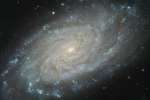 Spiral Galaxy NGC 3370 from Hubble
12.10.2008
Is this what our own Milky Way Galaxy looks like from far away? Similar in size and grand design to our home Galaxy (although without the central bar), spiral galaxy NGC 3370 lies about 100 million light-years away toward the constellation of the Lion (Leo).
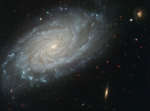 Spiral Galaxy NGC 3370 from Hubble
29.10.2011
Is this what our own Milky Way Galaxy looks like from far away? Similar in size and grand design to our home Galaxy (although without the central bar), spiral galaxy NGC 3370 lies about 100 million light-years away toward the constellation of the Lion (Leo).
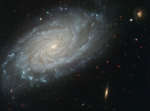 NGC 3370: A Sharper View
8.08.2013
Similar in size and grand design to our own Milky Way, spiral galaxy NGC 3370 lies about 100 million light-years away toward the constellation Leo. Recorded here in exquisite detail by the Hubble Space...
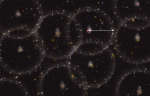 Baryon Acoustic Oscillations from SDSS III
20.01.2014
How large do things appear when far away? When peering across the universe, the answer can actually tell us about its average gravitational history and hence its composition. Toward this goal, the Baryon Oscillation...
|
January February March April May June July August September October |
|||||||||||||||||||||||||||||||||||||||||||||||||