
|
You entered: light
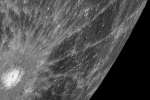 A Spectacular Rayed Crater on Mercury
3.11.2008
Why does Mercury have so many rayed craters? No one is sure. The robotic MESSENGER spacecraft that is taking unprecedented images as it swoops past the innermost planet has provided dramatic confirmation that Mercury has more rayed craters than Earth's Moon.
 Earth Rotating Under Very Large Telescopes
1.06.2011
Why is the Earth moving in the above video? Most time lapse videos of the night sky show the stars and sky moving above a steady Earth. Here, however, the frames have been digitally rotated so that it is the stars that stay (approximately) steady, and the Earth that moves beneath them.
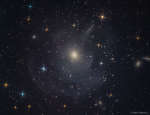 M89: Elliptical Galaxy with Outer Shells and Plumes
14.06.2017
Can you see them? This famous Messier object M89, a seemingly simple elliptical galaxy, is surrounded by faint shells and plumes. The cause of the shells is currently unknown, but possibly tidal tails related to debris left over from absorbing numerous small galaxies in the past billion years.
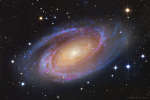 Bright Spiral Galaxy M81
17.09.2017
One of the brightest galaxies in planet Earth's sky is similar in size to our Milky Way Galaxy: big, beautiful M81. This grand spiral galaxy can be found toward the northern constellation of the Great Bear (Ursa Major).
 A Blue Hour Full Moon
26.08.2021
Nature photographers and other fans of planet Earth always look forward to the blue hour. That's the transition in twilight, just before sunrise or after sunset, when the Sun is below the horizon but land and sky are still suffused with a beautiful blue light.
 APOD: 2023 June 6 Б Star Eats Planet
6.06.2023
ItБs the end of a world as we know it. Specifically, the Sun-like star ZTF SLRN-2020 was seen eating one of its own planets. Although many a planet eventually dies by spiraling into their central star, the 2020 event, involving a Jupiter-like planet, was the first time it was seen directly.
 APOD: 2023 September 19 Б HH 211: Jets from a Forming Star
19.09.2023
Do stars always create jets as they form? No one is sure. As a gas cloud gravitationally contracts, it forms a disk that can spin too fast to continue contracting into a protostar. Theorists hypothesize that this spin can be reduced by expelling jets.
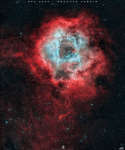 Roses are Red
14.02.2026
Roses are red, nebulas are too, and this Valentine's gift is a stunning view! Pictured is a loving look at the Rosette Nebula (NGC 2237): a cosmic bloom of bright young stars sitting atop a stem of glowing hot gas.
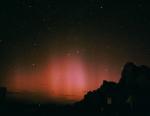 Aurora In West Texas Skies
15.09.2000
The aurora borealis, or northern lights, are not a common sight in the southwestern United States. But a strong solar coronal mass ejection in early August triggered geomagnetic storms and aurora which were widely reported, even under west Texas skies.
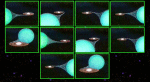 Black Hole Signature From Advective Disks
15.01.1997
What does a black hole look like? If alone, a black hole would indeed appear quite black, but many black hole candidates are part of binary star systems. So how does a black hole binary system look different from a neutron star binary system? The above drawings indicate it is difficult to tell!
|
January February March April May June July August September October |
|||||||||||||||||||||||||||||||||||||||||||||||||