
|
You entered: light
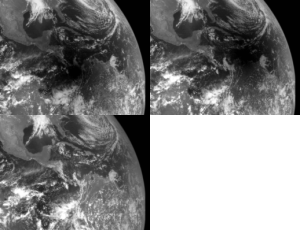 Moon Shadow
12.03.1998
When the Moon's shadow reached out and touched the Earth last month, the result was a Solar Eclipse. Such an eclipse is total only for observers located along a narrow path corresponding to the ground track of the shadow's dark central portion or "umbra".
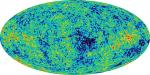 WMAP Resolves the Universe
11.07.2004
Analyses of a new high-resolution map of microwave light emitted only 380,000 years after the Big Bang appear to define our universe more precisely than ever before. The eagerly awaited results announced last year from the orbiting Wilkinson Microwave Anisotropy Probe resolve several long-standing disagreements in cosmology rooted in less precise data.
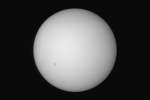 The International Space Station Transits the Sun
30.07.2008
That's no sunspot. It's the International Space Station (ISS) caught by chance passing in front of the Sun. Sunspots, individually, have a dark central umbra, a lighter surrounding penumbra, and no solar panels.
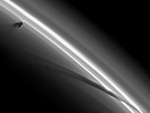 Prometheus Creating Saturn Ring Streamers
27.04.2009
What's causing those strange dark streaks in the rings of Saturn? Prometheus. Specifically, an orbital dance involving Saturn's moon Prometheus keeps creating unusual light and dark streamers in the F-Ring of Saturn. Now Prometheus orbits Saturn just inside the thin F-ring, but ventures into its inner edge about every 15 hours.
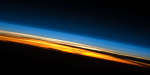 Sunset from the International Space Station
23.06.2010
What are these strange color bands being seen from the International Space Station? The Sun setting through Earth's atmosphere. Pictured above, a sunset captured last month by the ISS's Expedition 23 crew shows in vivid detail many layers of the Earth's thin atmosphere.
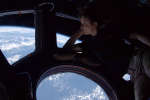 Home from Above
15.11.2010
There's no place like home. Peering out of the windows of the International Space Station (ISS), astronaut Tracy Caldwell Dyson takes in the planet on which we were all born, and to which she would soon return.
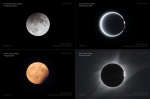 All the Eclipses of 2017
7.12.2017
As seen from planet Earth, all the lunar and solar eclipses of 2017 are represented at the same scale in these four panels. The year's celestial shadow play was followed through four different countries by one adventurous eclipse chaser.
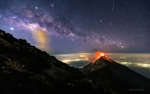 A Volcano of Fire under a Milky Way of Stars
27.05.2019
Sometimes it's hard to decide which is more impressive -- the land or the sky. On the land of the featured image, for example, the Volcano of Fire (VolcАn de Fuego) is seen erupting topped by red-hot, wind-blown ash and with streams of glowing lava running down its side.
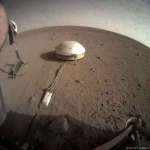 SEIS: Listening for Marsquakes
4.06.2019
If you put your ear to Mars, what would you hear? To find out, and to explore the unknown interior of Mars, NASA's Insight Lander deployed SEIS late last year, a sensitive seismometer that can detect marsquakes.
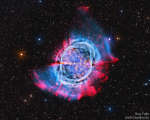 M27: The Dumbbell Nebula
12.07.2021
What will become of our Sun? The first hint of our Sun's future was discovered inadvertently in 1764. At that time, Charles Messier was compiling a list of diffuse objects not to be confused with comets.
|
January February March April May June July August September October |
|||||||||||||||||||||||||||||||||||||||||||||||||