
|
You entered: light
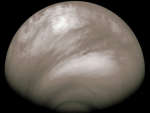 Mysterious Acid Haze on Venus
26.02.2008
Why did an acidic haze spread across Venus? The unusual clouds were discovered last July by ESA's robotic Venus Express spacecraft currently orbiting Venus. The bright and smooth haze was found by Venus...
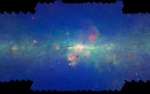 Spitzer s Milky Way
5.06.2008
The Spitzer Space Telescope's encompasing infrared view of the plane of our Milky Way Galaxy is hard to appreciate in just one picture. In fact, more than 800,000 frames of data from...
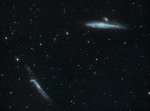 The Whale and the Hockey Stick
21.08.2009
NGC 4631 is a big beautiful spiral galaxy seen edge-on (top right) only 25 million light-years away towards the small northern constellation Canes Venatici. This galaxy's slightly distorted wedge shape suggests to some a cosmic herring and to others the popular moniker of The Whale Galaxy.
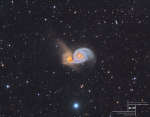 The Whirlpool Galaxy and Beyond
6.09.2016
Follow the handle of the Big Dipper away from the dipper's bowl, until you get to the handle's last bright star. Then, just slide your telescope a little south and west and you might find this stunning pair of interacting galaxies, the 51st entry in Charles Messier's famous catalog.
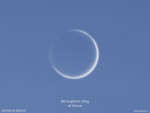 Atmospheric Ring of Venus
8.06.2020
Why is Venus surrounded by a bright ring? Sometimes called a ring of fire, this rare ring is caused by the Sun's light being visible all around an object. Usually seen around...
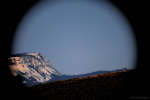 Find the Moon
11.07.2021
Where's the Moon? Somewhere in this image, the Earth's Moon is hiding. The entire Moon is visible, in its completely full phase, in plain sight. Even the photographer's keen eye couldn...
 APOD: 2023 April 16 Б M2 9: Wings of a Butterfly Nebula
16.04.2023
Are stars better appreciated for their art after they die? Actually, stars usually create their most artistic displays as they die. In the case of low-mass stars like our Sun and M2-9 pictured here, the stars transform themselves from normal stars to white dwarfs by casting off their outer gaseous envelopes.
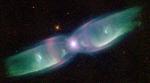 M2 9: Wings of a Butterfly Nebula
6.01.2002
Are stars better appreciated for their art after they die? Actually, stars usually create their most artistic displays as they die. In the case of low-mass stars like our Sun and M2-9 pictured above, the stars transform themselves from normal stars to white dwarfs by casting off their outer gaseous envelopes.
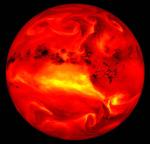 The Water Vapor Channel
23.03.2002
What alien planet's bizarre landscape lurks below these fiery-looking clouds? It's only planet Earth, of course ... as seen on the Water Vapor Channel. Hourly, images like this one (an infrared image shown in false-color) are brought to you by the orbiting Geostationary Operational Environmental Satellites' (GOES) multi-channel imagers.
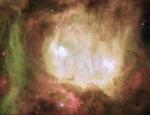 Halloween and the Ghost Head Nebula
31.10.2004
Halloween's origin is ancient and astronomical. Since the fifth century BC, Halloween has been celebrated as a cross-quarter day, a day halfway between an equinox (equal day / equal night) and a solstice (minimum day / maximum night in the northern hemisphere). With our modern calendar, however, the real cross-quarter day will occur next week.
|
January February March April May June July August September October |
|||||||||||||||||||||||||||||||||||||||||||||||||