
|
You entered: light
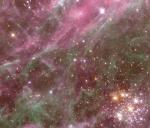 Denizen of the Tarantula Nebula
3.05.2003
The star cluster at lower right, cataloged as Hodge 301, is a denizen of the Tarantula Nebula. An evocative nebula in the southern sky, the sprawling cosmic Tarantula is an energetic star forming region some 168,000 light-years distant in our neighboring galaxy the Large Magellanic Cloud.
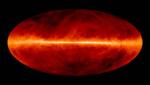 A Sky Full Of Hydrogen
28.02.1998
Interstellar space is filled with extremely tenuous clouds of gas which are mostly Hydrogen. The neutral hydrogen atom (HI in astronomer's shorthand) consists of 1 proton and 1 electron. The proton and electron spin like tops but can have only two orientations; spin axes parallel or anti-parallel.
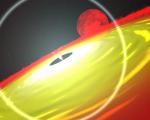 X Ray Pulsar
23.07.1998
This dramatic artist's vision shows a city-sized neutron star centered in a disk of hot plasma drawn from its enfeebled red companion star. Ravenously accreting material from the disk, the neutron star spins faster and faster emitting powerful particle beams and pulses of X-rays as it rotates 400 times a second.
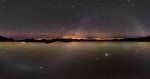 A Tale of Two Hemispheres
30.07.2011
A quest to find planet Earth's darkest night skies led to this intriguing panorama. In projection, the mosaic view sandwiches the horizons visible in all-sky images taken from the northern hemisphere's Canary Island of La Palma (top) and the south's high Atacama Desert between the two hemispheres of the Milky Way Galaxy.
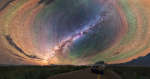 Colorful Airglow Bands Surround Milky Way
5.03.2018
Why would the sky glow like a giant repeating rainbow? Airglow. Now air glows all of the time, but it is usually hard to see. A disturbance however -- like an approaching storm -- may cause noticeable rippling in the Earth's atmosphere.
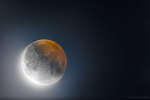 HDR: Earths Circular Shadow on the Moon
21.07.2019
What could create such a large circular shadow on the Moon? The Earth. Last week's full Moon -- the Buck Moon -- was so full that it fell almost exactly in a line with the Sun and the Earth. When that happens the Earth casts its shadow onto the Moon.
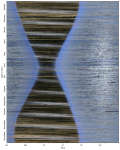 The Sky in 2021
20.03.2022
What if you could see the entire sky -- all at once -- for an entire year? That, very nearly, is what is pictured here. Every 15 minutes during 2021, an all-sky camera took an image of the sky over the Netherlands.
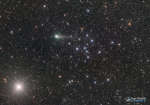 Comet C 2017 K2 (PanSTARRS)
29.06.2022
Imaged on June 20 2022, comet C/2017 K2 (PanSTARRS) shares this wide telescopic field of view with open star cluster IC 4665 and bright star Beta Ophiuchi, near a starry edge of the Milky Way.
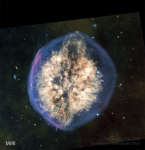 APOD: 2026 March 9 Б The Cranium Nebula from the Webb Telescope
8.03.2026
What's going on inside the head of this nebula? Dubbed the Exposed Cranium Nebula for its similarity to the human brain, what created the nebula remains a mystery. One thought is that the Cranium Nebula, also known as PMR 1, is a planetary nebula surrounding a white dwarf star.
 Crater On Ice
14.07.2000
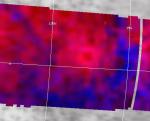
Impact craters are common on Earth's moon but on Jupiter's large ice moon Europa, they are very rare. Over time, both bodies have been subjected to an intense pounding by the solar system's formative debris, but geological activity on Europa's surface seems to have erased most of these impact scars.
|
January February March April May June July August September October |
|||||||||||||||||||||||||||||||||||||||||||||||||