
|
You entered: light
 Biomarker Phosphine Discovered in the Atmosphere of Venus
15.09.2020
Could there be life floating in the atmosphere of Venus? Although Earth's planetary neighbor has a surface considered too extreme for any known lifeform, Venus' upper atmosphere may be sufficiently mild for tiny airborne microbes. This usually disfavored prospect took an unexpected upturn yesterday with the announcement of the discovery of Venusian phosphine.
 M100: A Grand Design Spiral Galaxy
2.05.2024
Majestic on a truly cosmic scale, M100 is appropriately known as a grand design spiral galaxy. The large galaxy of over 100 billion stars has well-defined spiral arms, similar to our own Milky Way.
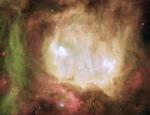 Halloween and the Ghost Head Nebula
31.10.2001
Halloween's origin is ancient and astronomical. Since the fifth century BC, Halloween has been celebrated as a cross-quarter day, a day halfway between an equinox (equal day / equal night) and a solstice (minimum day / maximum night in the northern hemisphere). With our modern calendar, however, the real cross-quarter day will occur next week.
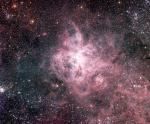 The Tarantula Zone
13.06.2002
The Tarantula Nebula is more than 1,000 light-years across - a giant emission nebula within our neighboring galaxy the Large Magellanic Cloud. Inside this cosmic arachnid lies a central young cluster of massive stars, cataloged as R136, whose intense radiation and strong winds have helped energize the nebular glow and shape the spidery filaments.
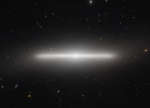 NGC 4452: An Extremely Thin Galaxy
9.11.2010
Why is there a line segment on the sky? In one of the more precise alignments known in the universe, what is pictured above is actually a disk galaxy being seen almost perfectly edge on. The image from the Hubble Space Telescope is a spectacular visual reminder of just how thin disk galaxies can be.
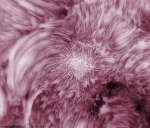 Fibrils Flower on the Sun
16.02.2015
When does the Sun look like a flower? In a specific color of red light emitted by hydrogen, as featured here, some regions of the solar chromosphere may resemble a rose. The color-inverted image was taken in 2014 October and shows active solar region 2177.
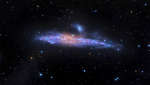 Star Streams and the Whale Galaxy
19.12.2015
NGC 4631 is a spiral galaxy found only 25 million light-years away, toward the well-trained northern constellation Canes Venatici. Seen ege-on, the galaxy is similar in size to the Milky Way. Its distorted wedge shape suggests to some a cosmic herring and to others its popular moniker, The Whale Galaxy.
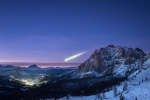 Major Fireball Meteor
17.11.2017
The sky glows with soft pinkish colors of fading twilight in this serendipitous mountaintop vista. Taken in subfreezing temperatures, the thoughtfully composed photo shows snowy, rugged peaks seen from a mountain pass on November 14. Below lies the village of La Villa, Alta Badia in Italy's Dolomite Alps.
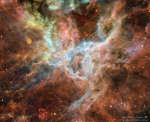 In the Heart of the Tarantula Nebula
20.05.2018
In the heart of monstrous Tarantula Nebula lies huge bubbles of energetic gas, long filaments of dark dust, and unusually massive stars. In the center of this heart, is a knot of stars so dense that it was once thought to be a single star.
 InSight on a Cloudy Day
4.10.2019
Clouds drift through the sky as the light fades near sunset in this three frame animated gif. The scene was captured on sol 145 beginning around 6:30pm local time by a camera on the Mars InSight lander. Of course, InSight's martian day, sol 145, corresponds to Earth calendar date April 25, 2019.
|
January February March April May June July August September October |
|||||||||||||||||||||||||||||||||||||||||||||||||