
|
You entered: light
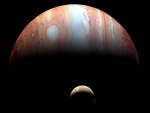 A Jupiter Io Montage from New Horizons
8.01.2008
As the New Horizons spacecraft sweeps through the Solar System, it is taking breathtaking images of the planets. In February of last year, New Horizons passed Jupiter and the ever-active Jovian moon Io. In this montage, Jupiter was captured in three bands of infrared light making the Great Red Spot look white.
 Alpha Centauri: The Closest Star System
3.07.2011
The closest star system to the Sun is the Alpha Centauri system. Of the three stars in the system, the dimmest -- called Proxima Centauri -- is actually the nearest star. The bright stars Alpha Centauri...
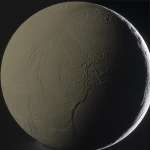 Enceladus Backlit by Saturn
8.02.2012
This moon is shining by the light of its planet. Specifically, a large portion of Enceladus pictured above is illuminated primarily by sunlight first reflected from the planet Saturn. The result is that the normally snow-white moon appears in the gold color of Saturn's cloud tops.
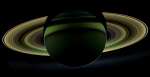 Saturn at Night
22.12.2012
Splendors seldom seen are revealed in this glorious picture from Saturn's shadow. Imaged by Cassini on October 17, 2012 during its 174th orbit, the ringed planet's night side is viewed from...
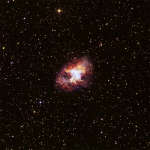 Cosmic Crab Nebula
25.07.2014
The Crab Pulsar, a city-sized, magnetized neutron star spinning 30 times a second, lies at the center of this tantalizing wide-field image of the Crab Nebula. A spectacular picture of one of our Milky Way's supernova remnants, it combines optical survey data with X-ray data from the orbiting Chandra Observatory.
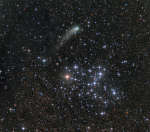 Messier 6 and Comet Siding Spring
17.10.2014
This looks like a near miss but the greenish coma and tail of Comet Siding Spring (C/2013 A1) are really 2,000 light-years or so away from the stars of open cluster Messier 6. They do appear close together though, along the same line-of-sight in this gorgeous October 9th skyscape toward the constellation Scorpius.
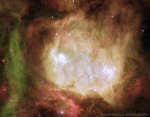 Halloween and the Ghost Head Nebula
30.10.2016
Halloween's origin is ancient and astronomical. Since the fifth century BC, Halloween has been celebrated as a cross-quarter day, a day halfway between an equinox (equal day / equal night) and a solstice (minimum day / maximum night in the northern hemisphere).
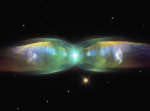 M2 9: Wings of a Butterfly Nebula
13.09.2020
Are stars better appreciated for their art after they die? Actually, stars usually create their most artistic displays as they die. In the case of low-mass stars like our Sun and M2-9 pictured here, the stars transform themselves from normal stars to white dwarfs by casting off their outer gaseous envelopes.
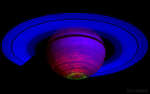 The Dancing Auroras of Saturn
27.06.2021
What drives auroras on Saturn? To help find out, scientists have sorted through hundreds of infrared images of Saturn taken by the Cassini spacecraft for other purposes, trying to find enough aurora images to correlate changes and make movies.
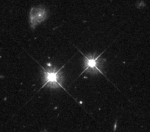 A Milestone Quasar
18.08.1996
Here is a rather typical quasar. But since quasars are so unusual it is quite atypical of most familiar objects. Of the two bright objects in the center of this photo, the quasar is on the left.
|
January February March April May June July August September October |
|||||||||||||||||||||||||||||||||||||||||||||||||