
|
You entered: light
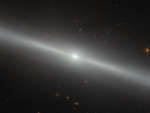 NGC 4762: A Galaxy on the Edge
4.11.2014
Why is there a bright line on the sky? What is pictured above is actually a disk galaxy being seen almost perfectly edge on. The image from the Hubble Space Telescope is a spectacular visual reminder of just how thin disk galaxies can be.
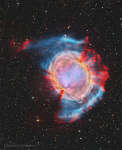 APOD: 2026 June 22 Б M27: The Dumbbell Nebula
22.06.2026
Is this what will become of our Sun? Quite possibly. The first hint of our Sun's future was discovered inadvertently in 1764. At that time, Charles Messier was compiling a list of diffuse objects not to be confused with comets.
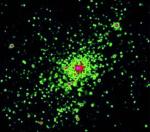 NGC 3603: X-Rays From A Starburst Cluster
24.01.2001
A mere 20,000 light-years from the Sun lies the NGC 3603 star cluster, a resident of the nearby Carina spiral arm of our Milky Way galaxy. Seen here in this recent false-color x-ray...
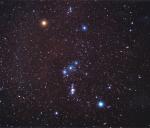 Orion on Film
7.02.2003
Orion, the Hunter, is one of the most easily recognizable constellations in planet Earth's night sky. But Orion's stars and nebulae don't look quite as colorful to the eye as they do in this lovely photograph, taken last month from Vekol Ranch south of Phoenix, Arizona, USA.
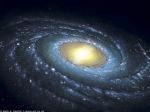 Milky Way Illustrated
4.01.2005
What does our Milky Way Galaxy look like from afar? Since we are stuck inside, and since opaque dust truncates our view in visible light, nobody knows for sure. Drawn above, however, is a good guess based on many different types of observations.
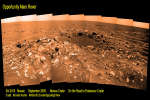 Nereus Crater on Mars
19.10.2009
It was along the way. The robotic rover Opportunity currently rolling across the Meridiani Plain on Mars has a destination of Endeavour Crater, a large crater over 20 kilometers across which may yield additional clues about the cryptic past of ancient Mars.
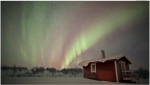 Trees, Stars, Aurora
9.02.2012
Have you ever seen an aurora? Auroras are occurring again with increasing frequency. With the Sun being unusually dormant over the past four years, the amount of Sun-induced auroras has been unusually low. More recently, however, our Sun has become increasingly active and exhibiting a greater abundance of sunspots, flares, and coronal mass ejections.
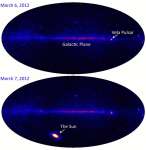 Solar Flare in the Gamma ray Sky
15.03.2012
What shines in the gamma-ray sky? The answer is usually the most exotic and energetic of astrophysical environments, like active galaxies powered by supermassive black holes, or incredibly dense pulsars, the spinning remnants of exploded stars.
 All Planets Panorama
25.02.2017
For 360 degrees, a view along the plane of the ecliptic is captured in this remarkable panorama, with seven planets in a starry sky. The mosaic was constructed using images taken during January 24-26, from Nacpan Beach, El Nido in Palawan, Philippines.
 APOD: 2024 September 10 Б Horsehead and Orion Nebulas
10.09.2024
The dark Horsehead Nebula and the glowing Orion Nebula are contrasting cosmic vistas. Adrift 1,500 light-years away in one of the night sky's most recognizable constellations, they appear in opposite corners of the above stunning mosaic.
|
January February March April May June July August September October |
|||||||||||||||||||||||||||||||||||||||||||||||||