
|
You entered: light
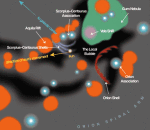 The Local Bubble and the Galactic Neighborhood
12.04.2000
What surrounds the Sun in this neck of the Milky Way Galaxy? Our current best guess is depicted in the above map of the surrounding 1500 light years constructed from various observations and deductions.
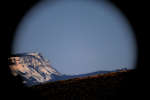 Spot the Moon
2.01.2012
Where's the full Moon? Somewhere in this image, the Earth's Moon is hiding. The entire Moon is visible, in its completely full phase, in plain sight. Even the photographer's keen...
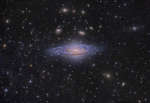 NGC 7331 and Beyond
17.12.2014
Big, beautiful spiral galaxy NGC 7331 is often touted as an analog to our own Milky Way. About 50 million light-years distant in the northern constellation Pegasus, NGC 7331 was recognized early on as a spiral nebula and is actually one of the brighter galaxies not included in Charles Messier's famous 18th century catalog.
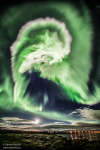 A Spiral Aurora over Iceland
15.09.2015
What's happened to the sky? Aurora! Captured late last month, this aurora was noted by Icelanders for its great brightness and quick development. The aurora resulted from a solar storm, with high energy particles bursting out from the Sun and through a crack in Earth's protective magnetosphere a few days later.
 Detailed View of a Solar Eclipse Corona
13.08.2017
Only in the fleeting darkness of a total solar eclipse is the light of the solar corona easily visible. Normally overwhelmed by the bright solar disk, the expansive corona, the sun's outer atmosphere, is an alluring sight.
 The Umbra of Earth
26.01.2019
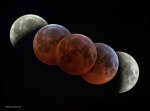
The dark, inner shadow of planet Earth is called the umbra. Shaped like a cone extending into space, it has a circular cross section most easily seen during a lunar eclipse. For example...
 Launch of the Solar Orbiter
11.02.2020
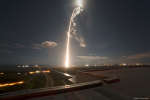
How does weather on the Sun affect humanity? To help find out, the European Space Agency (ESA) and NASA have just launched the Solar Orbiter. This Sun-circling robotic spaceship will monitor...
 APOD: 2020 August 25 Б Visualization: A Black Hole Accretion Disk
25.08.2020
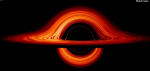
What would it look like to circle a black hole? If the black hole was surrounded by a swirling disk of glowing and accreting gas, then the great gravity of the black hole would deflect light emitted by the disk to make it look very unusual. The featured animated video gives a visualization.
 Explosions from White Dwarf Star RS Oph
22.08.2021
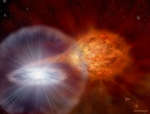
Spectacular explosions keep occurring in the binary star system named RS Ophiuchi. Every 20 years or so, the red giant star dumps enough hydrogen gas onto its companion white dwarf star to set off a brilliant thermonuclear explosion on the white dwarf's surface.
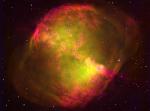 The Dumbbell Nebula in Hydrogen and Oxygen
13.01.2003
The first hint of what will become of our Sun was discovered inadvertently in 1764. At that time, Charles Messier was compiling a list of "annoying" diffuse objects not to be confused with "interesting" comets.
|
January February March April May June July August September October |
|||||||||||||||||||||||||||||||||||||||||||||||||