
|
You entered: light
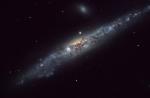 NGC 4631: The Whale Galaxy
22.01.2004
NGC 4631 is a big beautiful spiral galaxy seen edge-on only 25 million light-years away towards the small northern constellation Canes Venatici. This galaxy's slightly distorted wedge shape suggests to some a cosmic herring and to others the popular moniker of The Whale Galaxy.
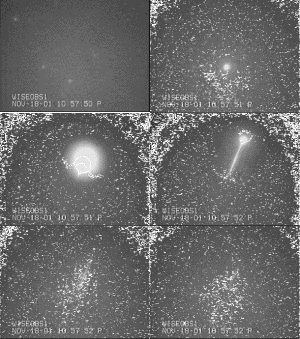 A Meteor Shower Fireball Movie
12.08.2005
Go outside tonight and see a celestial light show -- the later the better. Tonight is the peak of the month-long Perseid Meteor Shower. Although visible every year at this time, the Perseids are expected to appear particularly active this year due to the relative absence of glare from the Moon during the peak.
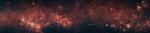 GLIMPSE the Milky Way
15.12.2005
Scroll right and gaze through the dusty plane of our Milky Way Galaxy in infrared light. The cosmic panorama is courtesy of the Galactic Legacy Infrared Mid-Plane Survey Extraordinaire (GLIMPSE) project and the Spitzer Space Telescope.
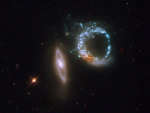 The Double Ring Galaxies of Arp 147 from Hubble
3.11.2008
How could a galaxy become shaped like a ring? Even more strange: how could two? The rim of the blue galaxy pictured on the right shows an immense ring-like structure 30,000 light years in diameter composed of newly formed, extremely bright, massive stars.
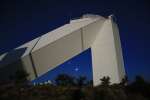 Bright Planets at McMath Pierce Solar Telescope
16.03.2012
Bright planets Venus and Jupiter are framed by the National Solar Observatory's McMath-Pierce Solar Telescope in this very astronomical scene. The photo was taken at Kitt Peak National Observatory on March 9.
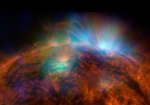 The Sun in X rays from NuSTAR
28.12.2014
Why are the regions above sunspots so hot? Sunspots themselves are a bit cooler than the surrounding solar surface because the magnetic fields that create them reduce convective heating. It is therefore unusual that regions overhead -- even much higher up in the Sun's corona -- can be hundreds of times hotter.
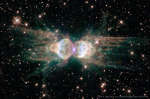 Planetary Nebula Mz3: The Ant Nebula
25.04.2015
Why isn't this ant a big sphere? Planetary nebula Mz3 is being cast off by a star similar to our Sun that is, surely, round. Why then would the gas that is streaming away create an ant-shaped nebula that is distinctly not round?
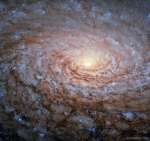 M63: The Sunflower Galaxy from Hubble
8.11.2016
One of the bright spiral galaxies visible in the north sky is M63, the Sunflower Galaxy. M63, also catalogued as NGC 5055, can be found with a small telescope toward the constellation of Hunting Dogs (Canes Venatici).
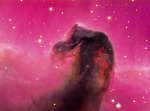 The Horsehead Nebula
26.12.2017
One of the most identifiable nebulae in the sky, the Horsehead Nebula in Orion, is part of a large, dark, molecular cloud. Also known as Barnard 33, the unusual shape was first discovered on a photographic plate in the late 1800s.
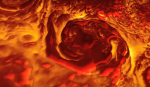 Flyover of Jupiters North Pole in Infrared
15.04.2018
What would it look like to fly over the North Pole of Jupiter? A fictional animation made from real images and data captured by NASA's Juno spacecraft shows an answer. Since the pole...
|
January February March April May June July August September October |
|||||||||||||||||||||||||||||||||||||||||||||||||