
|
You entered: light
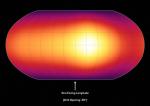 HD 189733b: Hot Jupiter
12.05.2007
HD 189733b is a Jupiter-sized planet known to orbit a star some 63 light-years away. But while the distant world is approximately the size of Jupiter, its close-in orbit makes it much hotter than our solar system's ruling gas giant.
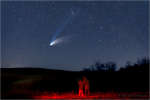 Hale Bopp: The Great Comet of 1997
13.10.2013
Sixteen years ago, Comet Hale-Bopp rounded the Sun and offered a dazzling spectacle in planet Earth's night. This stunning view, recorded shortly after the comet's 1997 perihelion passage, features the memorable tails of Hale-Bopp -- a whitish dust tail and blue ion tail.
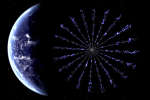 Heliopause Electrostatic Rapid Transit System
15.04.2016
Want to take a fast trip to the edge of the Solar System? Consider a ride on a Heliopause Electrostatic Rapid Transit System (HERTS). The concept is currently being tested and it might take only 10 to 15 years to make the trip of over 100 Astronomical Units (15 billion kilometers).
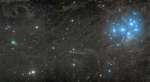 Two Comets and a Star Cluster
1.10.2017
Two unusual spots are on the move near the famous Pleiades star cluster. Shifting only a small amount per night, these spots are actually comets in our nearby Solar System that by chance wandered into the field of the light-years distant stars.
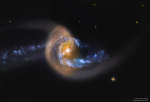 NGC 7714: Starburst after Galaxy Collision
8.10.2019
Is this galaxy jumping through a giant ring of stars? Probably not. Although the precise dynamics behind the featured image is yet unclear, what is clear is that the pictured galaxy, NGC 7714, has been stretched and distorted by a recent collision with a neighboring galaxy.
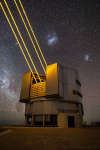 Firing Lasers to Tame the Sky
9.02.2021
Why do stars twinkle? Our atmosphere is to blame as pockets of slightly off-temperature air, in constant motion, distort the light paths from distant astronomical objects. Atmospheric turbulence is a problem for astronomers because it blurs the images of the sources they want to study.
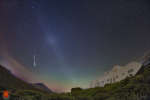 A Meteor and the Gegenschein
11.05.2021
Is the night sky darkest in the direction opposite the Sun? No. In fact, a rarely discernable faint glow known as the gegenschein (German for "counter glow") can be seen 180 degrees around from the Sun in an extremely dark sky. The gegenschein is sunlight back-scattered off small interplanetary dust particles.
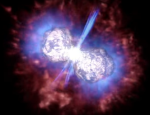 Eta Car: 3D Model of the Most Dangerous Star Known
8.02.2022
What's the most dangerous star near earth? Many believe it's Eta Carinae, a binary star system about 100 times the mass of the Sun, just 10,000 light years from earth.
 APOD: 2024 May 12 Б Red Aurora over Poland
11.05.2024
Northern lights don't usually reach this far south. Magnetic chaos in the Sun's huge Active Region 3664, however, produced a surface explosion that sent a burst of electrons, protons, and more massive, charged nuclei into the Solar System.
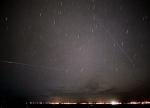 Mir Flares Farewell
22.03.2001
Streaking low across the western horizon after sunset, the Russian Mir space station makes a final pass through the evening sky above the coastal city of Salvador, Brazil. In this 5 minute 20 second time exposure made with ASA 800 film and a wide-angle lens on March 19, setting stars leave short, almost vertical trails.
|
January February March April May June July August September October |
|||||||||||||||||||||||||||||||||||||||||||||||||