
|
You entered: light
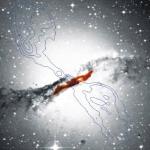 Centaurus A: The Galaxy Deep Inside
4.12.1998
Deep inside Centaurus A, the closest active galaxy to Earth, lies ... another galaxy! Cen A is a giant elliptical galaxy a mere 10 million light-years distant with a central jumble of stars, dust, and gas that probably hides a massive black hole.
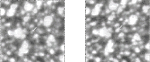 A MACHO View of Galactic Dark Matter
2.02.1996
What is our Galaxy made of? Stellar motions indicate there is much more mass than just stars and gas. Photographs like the two shown above may be yielding a clue about the dark matter, however.
 SpaceShipOne
27.06.2003
Slung below its equally innovative mothership dubbed White Knight, SpaceShipOne rides above planet Earth, photographed during a recent flight test. SpaceShipOne was designed and built by cutting-edge aeronautical engineer Burt Rutan and his company Scaled Composites to compete for the X Prize.
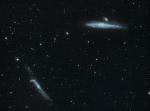 The Whale and the Hockey Stick
12.10.2007
NGC 4631 is a big beautiful spiral galaxy seen edge-on (top right) only 25 million light-years away towards the small northern constellation Canes Venatici. This galaxy's slightly distorted wedge shape suggests to some a cosmic herring and to others the popular moniker of The Whale Galaxy.
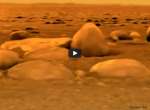 Huygens: Titan Descent Movie
21.01.2013
What would it look like to land on Saturn's moon Titan? The European Space Agency's Huygens probe set down on the Solar System's cloudiest moon in 2005, and a time-lapse video of its descent images was created.
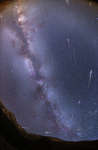 Moonless Meteors and the Milky Way
13.08.2015
Have you watched the Perseid meteor shower? Though the annual shower's predicted peak was last night, meteor activity should continue tonight (August 13/14), best enjoyed by just looking up in clear, dark skies after midnight. Of course, this year's Perseid shower has the advantage of being active near the August 14 New Moon.
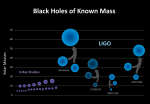 Black Holes of Known Mass
2.06.2017
Add GW170104 to the chart of black holes with known mass. The extremely energetic merger of two smaller black holes corresponds to the Laser Interferometer Gravitational-wave Observatory's (LIGO) third detection of gravitational waves.
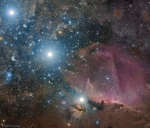 Orion: Belt, Flame, and Horsehead
4.06.2017
What surrounds the famous belt stars of Orion? A deep exposure shows everything from dark nebula to star clusters, all embedded in an extended patch of gaseous wisps in the greater Orion Molecular Cloud Complex.
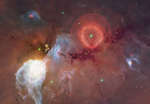 Massive Shell Expelling Star G79 29 0 46
25.09.2017
Stars this volatile are quite rare. Captured in the midst of dust clouds and visible to the right and above center is massive G79.29+0.46, one of less than 100 luminous blue variable stars (LBVs) currently known in our Galaxy.
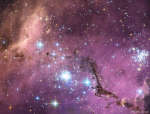 N11: Star Clouds of the LMC
29.04.2019
Massive stars, abrasive winds, mountains of dust, and energetic light sculpt one of the largest and most picturesque regions of star formation in the Local Group of Galaxies. Known as N11, the region...
|
January February March April May June July August September October |
|||||||||||||||||||||||||||||||||||||||||||||||||