
|
You entered: light
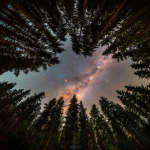 Framed by Trees: A Window to the Galaxy
19.07.2021
The photographer had this shot in mind for some time. He knew that objects overhead are the brightest -- since their light is scattered the least by atmospheric air. He also that knew the core of our Milky Way Galaxy was just about straight up near midnight around this time of year in South Australia.
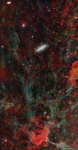 The Deep Sky Toward Andromeda
8.09.2021
What surrounds the Andromeda galaxy? Out in space, Andromeda (M31) is closely surrounded by several small satellite galaxies, and further out it is part of the Local Group of Galaxies -- of which our Milky Way galaxy is also a member.
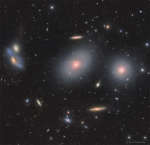 In the Heart of the Virgo Cluster
15.06.2022
The Virgo Cluster of Galaxies is the closest cluster of galaxies to our Milky Way Galaxy. The Virgo Cluster is so close that it spans more than 5 degrees on the sky - about 10 times the angle made by a full Moon.
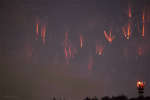 Red Sprite Lightning over the Czech Republic
12.09.2022
What are those red filaments in the sky? They are a rarely seen form of lightning confirmed only about 35 years ago: red sprites. Research has shown that following a powerful positive cloud-to-ground lightning...
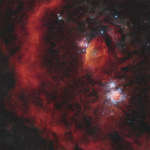 APOD: 2026 February 18 Б Orions Cradle
18.02.2026
Cradled in red-glowing hydrogen gas, stars are being born in Orion. These stellar nurseries lie at the edge of the giant Orion molecular cloud complex, some 1,500 light-years away. This detailed view spans...
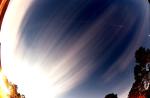 International Space Station Trail
14.12.2000
Still under construction, the International Space Station is literally becoming one of the brightest, fastest moving stars in the heavens. Despite illuminated clouds and bright light from a nearly full moon (lower left), this...
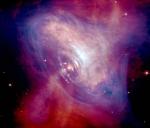 Composite Crab
4.09.2003
The Crab Pulsar, a city-sized, magnetized neutron star spinning 30 times a second, lies at the center of this composite image of the inner region of the well-known Crab Nebula. The spectacular picture combines...
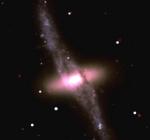 NGC 4650A: Strange Galaxy and Dark Matter
25.06.1998
This strangely distorted galaxy of stars is cataloged as NGC 4650A. It lies about 165 million light-years away in the southern constellation Centaurus. The complex system seems to have at least two parts, a flattened disk of stars with a dense, bright, central core and a sparse, sharply tilted ring of gas, dust and stars.
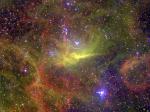 Nebulas Surrounding Wolf Rayet Binary
BAT99 49
Nebulas Surrounding Wolf Rayet Binary
BAT99 49
21.04.2004
How could two young stars power these colorful interstellar gas clouds? Although hidden by thick dust, the stars spew forceful ions and energetic radiation that cause the clouds to fragment and light up.
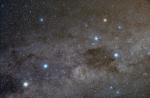 The Milky Way Near the Southern Cross
17.05.2007
The glow of the southern Milky Way and the well-known Southern Cross are featured in this colorful skyscape recorded in April over La Frontera, Chile. The Southern Cross (Crux) itself is at the right of the 20 degree wide field of view, topped by bright, yellowish star Gamma Crucis.
|
January February March April May June July August September October |
|||||||||||||||||||||||||||||||||||||||||||||||||