
|
You entered: light
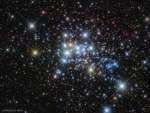 The Massive Stars in Westerlund 1
20.06.2017
Star cluster Westerlund 1 is home to some of the largest and most massive stars known. It is headlined by the star Westerlund 1-26, a red supergiant star so big that if placed in the center of our Solar System, it would extend out past the orbit of Jupiter.
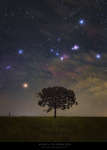 Orion Rising over Brazil
30.09.2019
Have you seen Orion lately? The next few months will be the best for seeing this familiar constellation as it rises continually earlier in the night. However, Orion's stars and nebulas won't look quite as colorful to the eye as they do in this fantastic camera image.
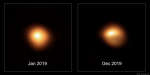 The Changing Surface of Fading Betelgeuse
17.02.2020
Besides fading, is Betelgeuse changing its appearance? Yes. The famous red supergiant star in the familiar constellation of Orion is so large that telescopes on Earth can actually resolve its surface -- although just barely.
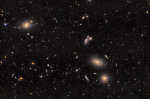 Virgo Cluster Galaxies
10.10.2020
Galaxies of the Virgo Cluster are scattered across this deep telescopic field of view. The cosmic scene spans about three Full Moons, captured in dark skies near Jalisco, Mexico, planet Earth. About 50 million light-years distant, the Virgo Cluster is the closest large galaxy cluster to our own local galaxy group.
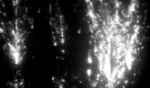 Sprite Lightning at 100000 Frames Per Second
4.01.2021
What causes sprite lightning? Mysterious bursts of light in the sky that momentarily resemble gigantic jellyfish have been recorded for over 30 years, but apart from a general association with positive cloud-to-ground lightning, their root cause remains unknown. Some thunderstorms have them -- most don't.
 APOD: 2025 September 18 Б Comet C/2025 R2 SWAN
18.09.2025
A new visitor from the outer Solar System, comet C/2025 R2 (SWAN) also known as SWAN25B was only discovered late last week, on September 11. That's just day before the comet reached perihelion, its closest approach to the Sun.
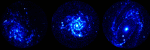 A Spiral Galaxy Gallery
9.04.1996
A progression of beautiful spiral galaxies is illustrated above with three photographs from NASA's Ultraviolet Imaging Telescope (UIT). Flying above the Earth's obscuring layer of atmosphere on the Space Shuttle Columbia during...
 A Quasar Portrait Gallery
25.11.1996
QUASARs (QUASi-stellAR objects) lie near the edge of the observable Universe. Discovered in 1963, astronomers were astounded - to be visible at such extreme distances of billions of light-years they must emit prodigious amounts of energy. Where does the energy come from?
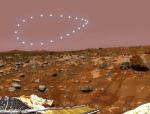 Martian Analemma
26.06.2003
On planet Earth, an analemma is the figure-8 loop you get when you mark the position of the Sun at the same time each day throughout the year. But similarly marking the position...
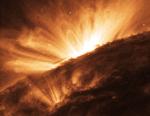 TRACE and the Active Sun
15.05.1998
This dramatic high resolution picture looking across the edge of the Sun was taken April 24th by a telescope on board the newly launched Transition Region and Coronal Explorer (TRACE) satellite. It shows graceful arcs of intensely hot gas suspended in powerful looping magnetic fields which soar above a solar active region.
|
January February March April May June July August September October |
|||||||||||||||||||||||||||||||||||||||||||||||||