
|
You entered: light
 The Orion Bullets
3.03.2019
Why are bullets of gas shooting out of the Orion Nebula? Nobody is yet sure. First discovered in 1983, each bullet is actually about the size of our Solar System, and moving at about 400 km/sec from a central source dubbed IRc2.
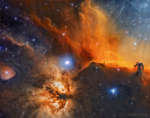 The Horsehead and Flame Nebulas
3.11.2021
The Horsehead Nebula is one of the most famous nebulae on the sky. It is visible as the dark indentation to the orange emission nebula at the far right of the featured picture. The horse-head feature is dark because it is really an opaque dust cloud that lies in front of the bright emission nebula.
 Explosions Discovered Near Galactic Center
28.02.1996
Tremendous explosions near the center of our Galaxy were discovered just this past December and are being announced today by a paper in Nature and a press conference at NASA. Bursts like these have...
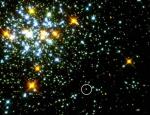 NGC 1818: Pick A Star
15.04.1998
This is NGC 1818, a youthful, glittering cluster of 20,000 stars residing in the Large Magellanic Cloud, 164,000 light-years away. Pick a star. Any star. Astronomers might pick the unassuming bluish-white one (circled) which appears to be a hot newly formed white dwarf star. What makes it so interesting?
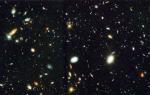 The Hubble Ultra Deep Field
9.03.2004
The above picture will be replaced later today (between 9 and 10 am EST) by the newly released Hubble Ultra Deep Field (HUDF). The HUDF is expected to be the deepest image of the universe ever taken in visible light.
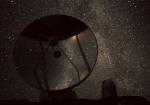 La Silla s Starry Night
23.09.2004
On clear, moonless nights, the stars still come out with a vengance above the high-altitude La Silla astronomical observatory. Taking advantage of a recent visit to this first European Southern Observatory (ESO) site constructed on a mountain top in Chile, ESO software engineer Nico Housen recorded this stunning sky view.
 Venus Returns to the Evening Sky
9.06.2005
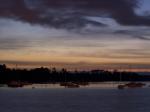
This serene image of boats moored in the harbor of l'нle-Tudy, Bretagne, France was taken on June 1st, about an hour after sunset. It also features Venus, third brightest celestial object after the Sun and Moon.
 Jupiters Clouds from Cassini
11.09.2005
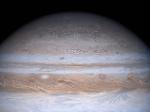
Gas giant Jupiter is the solar system's largest world with about 320 times the mass of planet Earth. Famous for its Great Red Spot, Jupiter is also known for its regular, equatorial cloud bands, visible in very modest sized telescopes.
 WMAP Resolves the Universe
25.09.2005
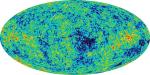
Analyses of a new high-resolution map of microwave light emitted only 380,000 years after the Big Bang appear to define our universe more precisely than ever before. The eagerly awaited results announced last year from the orbiting Wilkinson Microwave Anisotropy Probe resolve several long-standing disagreements in cosmology rooted in less precise data.
 Solar Moss
27.12.1999
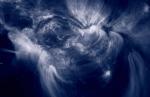
Discovered in recent close-up pictures of the Sun from NASA's Transition Region And Coronal Explorer (TRACE) spacecraft, this spongy-looking stuff has a temperature of 2 million degrees Fahrenheit ... and has been dubbed "Solar Moss". The false-color TRACE image above was recorded in extreme ultraviolet light on October 18.
|
January February March April May June July August September October |
|||||||||||||||||||||||||||||||||||||||||||||||||