
|
You entered: supernova
 APOD: 2024 September 4 Б NGC 6995: The Bat Nebula
3.09.2024
Can you see the bat? It haunts this cosmic close-up of the eastern Veil Nebula. The Veil Nebula itself is a large supernova remnant, the expanding debris cloud from the death explosion of a massive star.
 APOD: 2024 December 17 Б Near to the Heart Nebula
16.12.2024
What excites the Heart Nebula? First, the large emission nebula on the upper left, catalogued as IC 1805, looks somewhat like a human heart. The nebula glows brightly in red light emitted by its most prominent element, hydrogen, but this long-exposure image was also blended with light emitted by sulfur (yellow) and oxygen (blue).
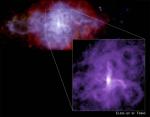 3C58: Pulsar Power
22.12.2004
Light from a star that exploded some ten thousand light-years away first reached our fair planet in the year 1181. Now known as supernova remnant 3C58, the region seen in this false-color image glows in x-rays, powered by a rapidly spinning neutron star or pulsar - the dense remains of the collapsed stellar core.
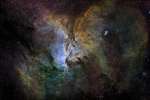 Shaping NGC 6188
2.05.2008
Dark shapes with bright edges winging their way through dusty NGC 6188 are tens of light-years long. The emission nebula is found near the edge of an otherwise dark large molecular cloud in the southern constellation Ara, about 4,000 light-years away.
 Wisps Surrounding the Horsehead Nebula
2.04.2019
The famous Horsehead Nebula in Orion is not alone. A deep exposure shows that the dark familiar shaped indentation, visible just below center, is part of a vast complex of absorbing dust and glowing gas.
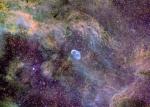 NGC 6888: A Tricolor Starfield
6.07.2006
NGC 6888, also known as the Crescent Nebula, is a cosmic bubble about 25 light-years across, blown by winds from its central, bright, massive star. Near the center of this intriguing widefield view of interstellar gas clouds and rich star fields of the constellation Cygnus, NGC 6888 is about 5,000 light-years away.
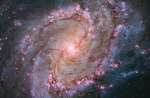 Spiral Galaxy M83: The Southern Pinwheel
28.01.2014
M83 is one of the closest and brightest spiral galaxies on the sky. Visible with binoculars in the constellation of Hydra, majestic spiral arms have prompted its nickname as the Southern Pinwheel. Although discovered...
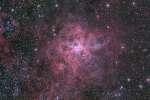 The Cosmic Web of the Tarantula Nebula
17.02.2014
It is the largest and most complex star forming region in the entire galactic neighborhood. Located in the Large Magellanic Cloud, a small satellite galaxy orbiting our Milky Way galaxy, the region's spidery appearance is responsible for its popular name, the Tarantula nebula. This tarantula, however, is about 1,000 light-years across.
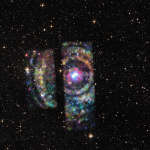 X ray Echoes from Circinus X 1
4.08.2015
Circinus X-1 is an X-ray binary star known for its erratic variability. In the bizarre Circinus X-1 system, a dense neutron star, the collapsed remnant of a supernova explosion, orbits with a more ordinary stellar companion.
 Runaway Star Alpha Camelopardalis
27.04.2023
Like a ship plowing through cosmic seas, runaway star Alpha Camelopardalis has produced this graceful arcing bow wave or bow shock. The massive supergiant star moves at over 60 kilometers per second through space, compressing the interstellar material in its path.
|
January February March April May June July August September October |
|||||||||||||||||||||||||||||||||||||||||||||||||