
|
You entered: supernova
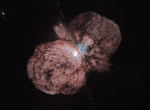 Doomed Star Eta Carinae
16.08.1998
Eta Carinae may be about to explode. But no one knows when - it may be next year, it may be one million years from now. Eta Carinae's mass - about 100 times greater than our Sun - makes it an excellent candidate for a full blown supernova.
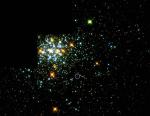 NGC 1818: Pick A Star
31.05.2003
This is NGC 1818, a youthful, glittering cluster of 20,000 stars residing in the Large Magellanic Cloud, 180,000 light-years away. Pick a star. Any star. Astronomers might pick the unassuming bluish-white one (circled) which appears to be a hot newly formed white dwarf star. What makes it so interesting?
 Light Echoes from V838 Mon
27.11.2005
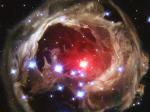
What caused this outburst of V838 Mon? For reasons unknown, star V838 Mon's outer surface suddenly greatly expanded with the result that it became the brightest star in the entire Milky Way Galaxy in January 2002. Then, just as suddenly, it faded.
 Light Echoes from V838 Mon
3.02.2008
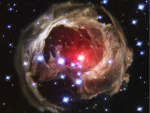
What caused this outburst of V838 Mon? For reasons unknown, star V838 Mon's outer surface suddenly greatly expanded with the result that it became the brightest star in the entire Milky Way Galaxy in January 2002. Then, just as suddenly, it faded.
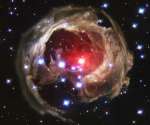 Light Echoes from V838 Mon
22.11.2009
What caused this outburst of V838 Mon? For reasons unknown, star V838 Mon's outer surface suddenly greatly expanded with the result that it became the brightest star in the entire Milky Way Galaxy in January 2002. Then, just as suddenly, it faded.
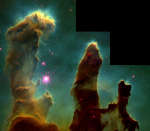 M16: Pillars of Creation
22.07.2012
It was one of the most famous images of the 1990s. This image, taken with the Hubble Space Telescope in 1995, shows evaporating gaseous globules (EGGs) emerging from pillars of molecular hydrogen gas and dust. The giant pillars are light years in length and are so dense that interior gas contracts gravitationally to form stars.
 NGC 6888: The Crescent Nebula
28.11.2025
NGC 6888, also known as the Crescent Nebula, is a about 25 light-years across, a cosmic bubble blown by winds from its central, massive star. This deep telescopic image includes narrowband image data, to isolate light from hydrogen and oxygen atoms.
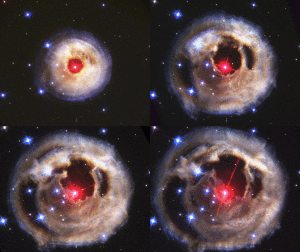 V838 Light Echo: The Movie
2.04.2003
What caused this outburst of V838 Mon? For reasons unknown, star V838 Mon's outer surface suddenly greatly expanded with the result that it became the brightest star in the entire Milky Way Galaxy. Then, just as suddenly, it faded.
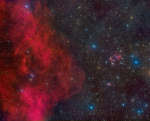 Barnard Stares at NGC 2170
19.01.2013
A gaze across a cosmic skyscape, this telescopic mosaic reveals the continuous beauty of things that are. The evocative scene spans some 6 degrees or 12 Full Moons in planet Earth's sky. At the left, folds of red, glowing gas are a small part of an immense, 300 light-year wide arc.
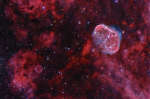 Cygnus: Bubble and Crescent
4.12.2015
These clouds of gas and dust drift through rich star fields along the plane of our Milky Way Galaxy toward the high flying constellation Cygnus. Caught within the telescopic field of view are the Soap Bubble (lower left) and the Crescent Nebula (upper right).
|
January February March April May June July August September October |
|||||||||||||||||||||||||||||||||||||||||||||||||