
|
You entered: image
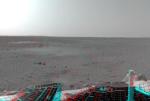 Spirit s 3D View Towards Sleep Hollow
6.01.2004
Working late, tired mission members nicknamed the smooth-looking depression to the left of center in this image from the martian surface, Sleepy Hollow. The picture is a portion of the 3D panorama of the Spirit rover's landing site released yesterday, constructed with data from the Mars rover's navigation cameras.
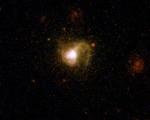 POX 186: Not So Long Ago
28.02.2004
Not so long ago and not so far, far away, a galaxy was born. Seen in this Hubble Space Telescope image, the island universe of stars, gas, and dust cataloged as POX 186 is a mere 68 million light-years distant toward an uncrowded region in the constellation Virgo.
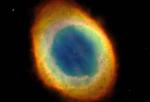 M57: The Ring Nebula
4.07.2004
Except for the rings of Saturn, the Ring Nebula (M57) is probably the most famous celestial band. This planetary nebula's simple, graceful appearance is thought to be due to perspective -- our view from planet Earth looking straight into what is actually a barrel-shaped cloud of gas shrugged off by a dying central star.
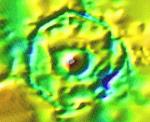 Mjølnir: Impact Crater
10.06.1999
The stark surface of Earth's moon is pocked with large craters, records of a history of fierce bombardment by the solar system's formative debris. It may be difficult to imagine, but nearby planet Earth itself has endured a similar cosmic pounding, though oceans, weathering, and geological
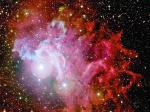 The Flaming Star Nebula from CFHT
28.02.2006
Rippling dust and gas lanes give the Flaming Star Nebula its name. The red and purple colors of the nebula are present in different regions and are created by different processes. The bright star...
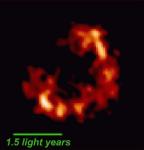 Supernova Remnant In M82
16.12.1999
This false-color radio wavelength picture of an expanding stellar debris cloud is the product of one of the largest radio astronomy experiments ever. Combining the output of 20 radio telescopes scattered around planet Earth...
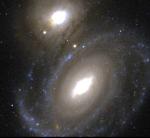 Galaxies Away
21.08.1999
This striking pair of galaxies is far, far away ... about 350 million light-years from Earth. Cataloged as AM0500-620, the pair is located in the southern constellation Dorado. The background elliptical and foreground spiral galaxy are representative of two of the three major classes of galaxies which inhabit our Universe.
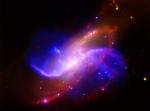 The Arms of NGC 4258
11.04.2007
Better known as M106, bright spiral galaxy NGC 4258 is about 30 thousand light years across and 21 million light years away toward the northern constellation Canes Venatici. The yellow and red hues in this composite image show the galaxy's sweeping spiral arms as seen in visible and infrared light.
 Could Hydrogen Peroxide Life Survive on Mars
28.08.2007
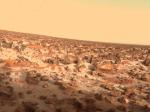
Is there life on Mars? Although no unambiguous evidence for indigenous life on Mars has ever been found, a more speculative question -- could some life forms survive on Mars -- has taken on a new twist.
 APOD: 2008 April 2- Globular Cluster M55 from CFHT
2.04.2008
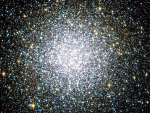
The fifty-fifth entry in Charles Messier's catalog, M55 is a large and lovely globular cluster of around 100,000 stars. Only 20,000 light-years away in the constellation Sagittarius, M55 appears to earth-bound observers to be nearly 2/3 the size of the full moon.
|
January February March April May June July August September |
|||||||||||||||||||||||||||||||||||||||||||||||||