
|
You entered: image
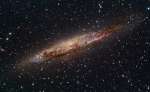 Nearby Spiral Galaxy NGC 4945
23.01.2013
Large spiral galaxy NGC 4945 is seen edge-on near the center of this cosmic galaxy portrait. In fact, NGC 4945 is almost the size of our own Milky Way Galaxy. Its own dusty disk, young blue star clusters, and pink star forming regions standout in the sharp, colorful telescopic image.
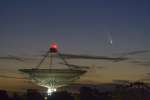 PanSTARRS over Parkes
9.03.2013
Sweeping quickly through southern skies on March 5, Comet PanSTARRS (C/2011 L4) follows the Sun toward the western horizon in this twilight scene. In the foreground is Australia's CSIRO Parkes Radio Telescope, a 64 meter wide steerable dish that is no stranger to the space age exploration of comets.
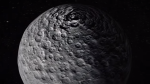 Fly Over Dwarf Planet Ceres
10.06.2015
What would it look like to fly over dwarf planet Ceres? Animators from the German Aerospace Center recently took actual images and height data from NASA's robotic Dawn mission -- currently visiting Ceres -- to generate several fascinating virtual sequences.
 Gemini Observatory North
15.10.2016
It does look like a flying saucer, but this technologically advanced structure is not here to deliver the wise extraterrestrial from the scifi classic movie The Day the Earth Stood Still. It is here to advance our knowledge of the Universe though.
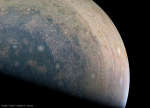 Cloud Swirls around Southern Jupiter from Juno
13.02.2017
Juno just completed its fourth pass near Jupiter. Launched from Earth in 2011 and arriving at Jupiter just last July, robotic Juno concluded its latest elliptical orbit around our Solar System's largest planet 11 days ago.
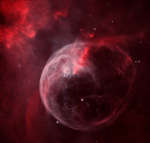 NGC 7635: The Bubble Nebula
19.04.2018
Blown by the wind from a massive star, this interstellar apparition has a surprisingly familiar shape. Cataloged as NGC 7635, it is also known simply as The Bubble Nebula. Although it looks delicate, the 7 light-year diameter bubble offers evidence of violent processes at work.
 The Orion Bullets
3.03.2019
Why are bullets of gas shooting out of the Orion Nebula? Nobody is yet sure. First discovered in 1983, each bullet is actually about the size of our Solar System, and moving at about 400 km/sec from a central source dubbed IRc2.
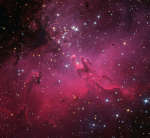 M16 and the Eagle Nebula
15.11.2019
A star cluster around 2 million years young surrounded by natal clouds of dust and glowing gas, M16 is also known as The Eagle Nebula. This beautifully detailed portrait of the region was made with groundbased narrow and broadband image data.
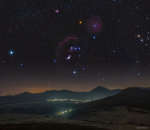 Orion over the Central Bohemian Highlands
18.02.2020
Do you recognize this constellation? Setting past the Central Bohemian Highlands in the Czech Republic is Orion, one of the most identifiable star groupings on the sky and an icon familiar to humanity for over 30,000 years.
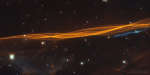 Filaments of the Cygnus Loop
28.09.2020
What lies at the edge of an expanding supernova? Subtle and delicate in appearance, these ribbons of shocked interstellar gas are part of a blast wave at the expanding edge of a violent stellar explosion that would have been easily visible to humans during the late stone age, about 20,000 years ago.
|
January February March April May June July August September |
|||||||||||||||||||||||||||||||||||||||||||||||||