
|
You entered: stars
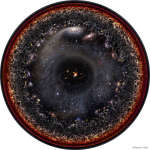 The Observable Universe
7.05.2018
How far can you see? Everything you can see, and everything you could possibly see, right now, assuming your eyes could detect all types of radiations around you -- is the observable universe. In visible...
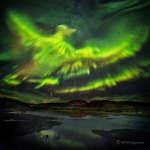 A Phoenix Aurora over Iceland
2.01.2021
All of the other aurora watchers had gone home. By 3:30 am in Iceland, on a quiet September night, much of that night's auroras had died down. Suddenly, unexpectedly, a new burst of particles streamed down from space, lighting up the Earth's atmosphere once again.
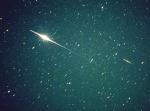 Iridium Flare
2.04.1998
Have you seen an Iridium flare? Satellites in low Earth orbit reflect sunlight and are often visible gliding across early evening and predawn skies. But sun glints from Iridium commercial digital communications satellites are providing the most spectacular sightings.
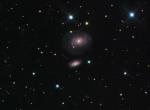 NGC 1 and NGC 2
19.08.2005
Beautiful nebulae, clusters, and galaxies that grace planet Earth's night sky are often known by their New General Catalog designation or NGC number. That classic listing was compiled by John Louis Emil Dreyer, remarkable director of the Armagh Observatory from 1882 to 1916.
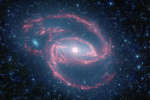 NGC 1097: Spiral Galaxy with a Central Eye
27.07.2009
What's happening at the center of spiral galaxy NGC 1097? No one is sure, but it likely involves a supermassive black hole. Matter falling in from a bar of stars and gas across the center is likely being heated by an extremely energetic region surrounding the central black hole.
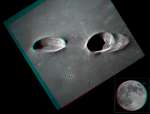 Messier Craters in Stereo
8.06.2013
Many bright nebulae and star clusters in planet Earth's sky are associated with the name of astronomer Charles Messier, from his famous 18th century catalog. His name is also given to these two large and remarkable craters on the Moon.
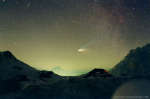 Comet Hale Bopp Over Val Parola Pass
8.04.2017
Comet Hale-Bopp, the Great Comet of 1997, became much brighter than any surrounding stars. It was seen even over bright city lights. Away from city lights, however, it put on quite a spectacular show. Here Comet Hale-Bopp was photographed above Val Parola Pass in the Dolomite mountains surrounding Cortina d'Ampezzo, Italy.
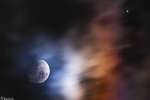 APOD: 2020 September 2 Б Jupiter and the Moons
1.09.2020
How many moons do you see? Many people would say one, referring to the Earth's Moon, prominent on the lower left. But take a closer look at the object on the upper right.
 A View Toward M106
21.02.2024
Big, bright, beautiful spiral, Messier 106 dominates this cosmic vista. The nearly two degree wide telescopic field of view looks toward the well-trained constellation Canes Venatici, near the handle of the Big Dipper. Also...
 Mir Flares Farewell
22.03.2001
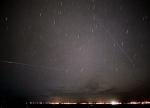
Streaking low across the western horizon after sunset, the Russian Mir space station makes a final pass through the evening sky above the coastal city of Salvador, Brazil. In this 5 minute 20 second time exposure made with ASA 800 film and a wide-angle lens on March 19, setting stars leave short, almost vertical trails.
|
January February March April May June July August September October |
|||||||||||||||||||||||||||||||||||||||||||||||||