
|
You entered: stars
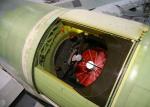 SOFIA s Window Seat
25.02.2006
Earlier this month, a 2.5-meter diameter infrared telescope was permanently assigned a window seat, looking through this opening in the fuselage of a historic Boeing 747 aircraft. The telescope mirror, about the size of the Hubble Space Telescope mirror, is protected by a red covering.
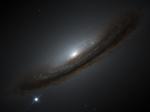 Rumors of a Strange Universe
24.12.2006
Eight years ago results were first presented indicating that most of the energy in our universe is not in stars or galaxies but is tied to space itself. In the language of cosmologists, a large cosmological constant is directly implied by new distant supernovae observations.
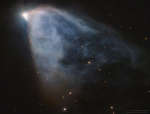 NGC 2261: Hubble s Variable Nebula
8.11.2017
What causes Hubble's Variable Nebula to vary? The unusual nebula featured here changes its appearance noticeably in just a few weeks. Discovered over 200 years ago and subsequently cataloged as NGC 2661, the remarkable nebula is named for Edwin Hubble, who studied it early last century.
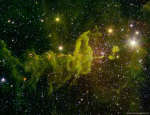 The Spider Nebula in Infrared
4.09.2019
Will the spider ever catch the fly? Not if both are large emission nebulas toward the constellation of the Charioteer (Auriga). The spider-shaped gas cloud on the left is actually an emission nebula labelled...
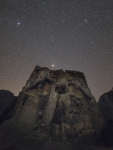 Mars, Pleiades, and Andromeda over Stone Lions
13.10.2020
Three very different -- and very famous -- objects were all captured in a single frame last month. On the upper left is the bright blue Pleiades, perhaps the most famous cluster of stars on the night sky. The Pleiades (M45) is about 450 light years away and easily found a few degrees from Orion.
 APOD: 2025 May 7 Б Galaxy Wars: M81 versus M82
7.05.2025
In the upper left corner, surrounded by blue arms and dotted with red nebulas, is spiral galaxy M81. In the lower right corner, marked by a light central line and surrounded by red glowing gas, is irregular galaxy M82.
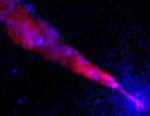 The Energetic Jet from Centaurus A
1.05.2003
The center of well-studied active galaxy Centaurus A is hidden from the view of optical telescopes by a cosmic jumble of stars, gas, and dust. But both radio and x-ray telescopes can trace the remarkable jet of high-energy particles streaming from the galaxy's core.
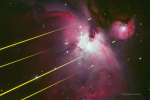 Nebula with Laser Beams
29.03.2017
Four laser beams cut across this startling image of the Orion Nebula, as seen from ESO's Paranal Observatory in the Atacama desert on planet Earth. Not part of an interstellar conflict, the lasers...
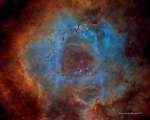 When Roses Aren t Red
22.02.2018
Not all roses are red of course, but they can still be very pretty. Likewise, the beautiful Rosette Nebula and other star forming regions are often shown in astronomical images with a predominately red hue, in part because the dominant emission in the nebula is from hydrogen atoms.
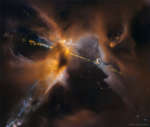 Duel Particle Beams in Herbig Haro 24
11.03.2018
This might look like a double-bladed lightsaber, but these two cosmic jets actually beam outward from a newborn star in a galaxy near you. Constructed from Hubble Space Telescope image data, the stunning scene...
|
January February March April May June July August September October |
|||||||||||||||||||||||||||||||||||||||||||||||||