
|
You entered: image
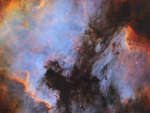 North America and the Pelican
16.09.2021
Fans of our fair planet might recognize the outlines of these cosmic clouds. On the left, bright emission outlined by dark, obscuring dust lanes seems to trace a continental shape, lending the popular name North America Nebula to the emission region cataloged as NGC 7000.
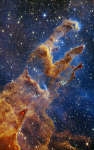 Pillars of Creation
20.10.2022
A now famous picture from the Hubble Space Telescope featured these star forming columns of cold gas and dust light-years long inside M16, the Eagle Nebula, dubbed the Pillars of Creation. This James Webb Space Telescope NIRCam image expands Hubble's exploration of that region in greater detail and depth inside the iconic stellar nursery.
 Peculiar Galaxies of Arp 273
9.01.2025
The colorful, spiky stars are in the foreground of this image taken with a small telescope on planet Earth. They lie well within our own Milky Way Galaxy. But the two eye-catching galaxies in the frame lie far beyond the Milky Way, at a distance of over 300 million light-years.
 APOD: 2025 September 18 Б Comet C/2025 R2 SWAN
18.09.2025
A new visitor from the outer Solar System, comet C/2025 R2 (SWAN) also known as SWAN25B was only discovered late last week, on September 11. That's just day before the comet reached perihelion, its closest approach to the Sun.
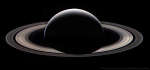 APOD: 2026 June 1 Б Saturn at Night
1.06.2026
Telescopic views of Saturn and its beautiful rings often make it the star of star parties. But this stunning view of the outer gas gaint planet's rings and night side just isn't possible from telescopes in the vicinity of planet Earth.
 Surrounded by Mars
18.09.2001
Just after landing on Mars in 1997, the robotic Mars Pathfinder main station took a quick first look around. This insurance panorama was taken even before the Sagan Memorial Station camera was raised to its two-meter-high perch. The full view is best seen by slowly scrolling to the right.
 Fireworks and Shooting Stars
9.08.2002
Experimenting with a new telescope and camera, photographer Jim Steele captured this surreal but festive image of fireworks in the night sky above Ashland, Oregon. The date was July 4th and the fiery streaks were part of the traditional annual celebration of independence day in the United States.
 A Quasar Portrait Gallery
25.11.1996
QUASARs (QUASi-stellAR objects) lie near the edge of the observable Universe. Discovered in 1963, astronomers were astounded - to be visible at such extreme distances of billions of light-years they must emit prodigious amounts of energy. Where does the energy come from?
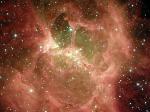 Spooky Star Forming Region DR 6
1.11.2004
How could stars form such a spooky and familiar shape as a human skull? First, the complex process of star formation creates nebulas of many shapes and sizes -- it is human perception that identifies the skull shape.
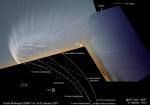 A Tail of Two Hemispheres
1.02.2007
By January 19/20 Comet McNaught's magnificent dust tail stretched for about 150 million kilometers (~1 AU), requiring images from both southern and northern hemispheres of planet Earth to take it all in.
|
January February March April May June July August September |
|||||||||||||||||||||||||||||||||||||||||||||||||