
|
You entered: image
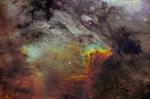 IC 5067: A Piece of the Pelican
19.10.2007
(xxxedit and linkxxx) The prominent ridge of emission featured in this dramatic skyscape is cataloged as IC 5067. Part of a larger emission nebula with a distinctive shape, popularly called The Pelican Nebula, the ridge spans about 10 light-years following the curve of the cosmic pelican's head and neck.
 The Large Cloud of Magellan
19.12.2008
The 16th century Portuguese navigator Ferdinand Magellan and his crew had plenty of time to study the southern sky during the first circumnavigation of planet Earth. As a result, two fuzzy cloud-like objects easily...
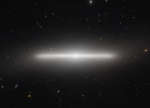 NGC 4452: An Extremely Thin Galaxy
9.11.2010
Why is there a line segment on the sky? In one of the more precise alignments known in the universe, what is pictured above is actually a disk galaxy being seen almost perfectly edge on. The image from the Hubble Space Telescope is a spectacular visual reminder of just how thin disk galaxies can be.
 The Upper Michigan Blizzard of 1938
22.01.2014
Yes, but can your blizzard do this? In Upper Michigan's Storm of the Century in 1938, some snow drifts reached the level of utility poles. Nearly a meter of new and unexpected snow fell over two days in a storm that started 76 years ago tomorrow.
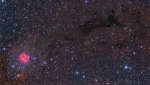 Cocoon Nebula Wide Field
18.09.2014
In this crowded starfield covering over 2 degrees within the high flying constellation Cygnus, the eye is drawn to the Cocoon Nebula. A compact star forming region, the cosmic Cocoon punctuates a long trail of obscuring interstellar dust clouds.
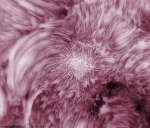 Fibrils Flower on the Sun
16.02.2015
When does the Sun look like a flower? In a specific color of red light emitted by hydrogen, as featured here, some regions of the solar chromosphere may resemble a rose. The color-inverted image was taken in 2014 October and shows active solar region 2177.
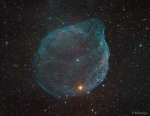 Sharpless 308: Star Bubble
23.06.2015
Blown by fast winds from a hot, massive star, this cosmic bubble is huge. Cataloged as Sharpless 2-308 it lies some 5,200 light-years away toward the constellation of the Big Dog (Canis Major) and covers slightly more of the sky than a Full Moon.
 Tardigrade in Moss
26.03.2017
Is this an alien? Probably not, but of all the animals on Earth, the tardigrade might be the best candidate. That's because tardigrades are known to be able to go for decades without...
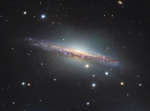 NGC 1055 Close up
9.11.2017
Big, beautiful spiral galaxy NGC 1055 is a dominant member of a small galaxy group a mere 60 million light-years away toward the aquatically intimidating constellation Cetus. Seen edge-on, the island universe spans over 100,000 light-years, a little larger than our own Milky Way.
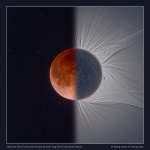 Total Solar Lunar Eclipse
9.02.2018
This digitally processed and composited picture creatively compares two famous eclipses in one; the total lunar eclipse (left) of January 31, and the total solar eclipse of August 21, 2017. The Moon appears near mid-totality in both the back-to-back total eclipses.
|
January February March April May June July August September |
|||||||||||||||||||||||||||||||||||||||||||||||||