
|
You entered: image
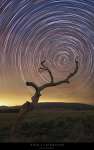 APOD: 2026 April 16 Б South Celestial Tree
16.04.2026
If you live in the northern hemisphere, you may have learned how to locate the North Star, Polaris, in the night sky. It can be used to find north, and it approximately marks the northern celestial pole.
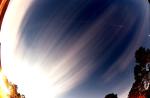 International Space Station Trail
14.12.2000
Still under construction, the International Space Station is literally becoming one of the brightest, fastest moving stars in the heavens. Despite illuminated clouds and bright light from a nearly full moon (lower left), this...
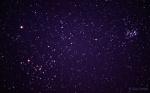 Saturn and Vesta in Taurus
18.01.2002
Last November, while skygazing toward the constellation Taurus, astrophotographer Joe Orman arranged this time exposure to include the lovely Hyades and Pleiades star clusters in the field of his telephoto lens. A distance...
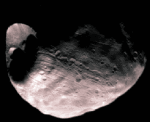 Phobos: Doomed Moon of Mars
2.10.1995
Mars, the red planet named for the Roman god of war, has two tiny moons, Phobos and Deimos, whose names are derived from the Greek for Fear and Panic. These Martian moons may well...
 Pictured: An Ancient Martian?
8.08.1996
Alien! Alien? Is this what an ancient Martian looked like? The tube-like form on the above highly magnified image is now believed by many to be a fossil of a simple Martian organism that lived over 3.6 billion years ago.
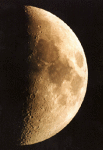 The Moon and All the Crashes
19.09.1996
A clear blue summer sky finally grows dark and the new telescope, hastily set up in the backyard, generates excitment and anticipation. "I bought it for the kids ...", Dad assures himself as he over-anxiously supervises the two young boys' efforts to center a bright, first quarter Moon, in the finder.
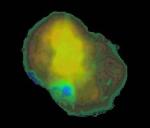 X-Rays From IC 443
2.05.1997
The life-cycles of stars help drive the ecology of our Galaxy, churning, processing, and redistributing matter. Massive stars reach a spectacular evolutionary endpoint - supernovae explosions which blast off their outer layers, violently merging stellar material with the gas and dust of the Milky Way. The supernova remnant IC 443 is typical of the aftermath.
 Bright Lights, Dark City
18.08.2003
Last Thursday, millions of people had an unexpectedly good view of a dark night sky. Usually, the reflection of city lights off of local air impurities makes it hard for casual observers to see more than a handful of stars from a bright urban area.
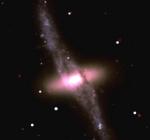 NGC 4650A: Strange Galaxy and Dark Matter
25.06.1998
This strangely distorted galaxy of stars is cataloged as NGC 4650A. It lies about 165 million light-years away in the southern constellation Centaurus. The complex system seems to have at least two parts, a flattened disk of stars with a dense, bright, central core and a sparse, sharply tilted ring of gas, dust and stars.
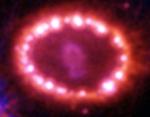 SN1987A s Cosmic Pearls
20.02.2004
In February 1987, light from the brightest stellar explosion seen in modern times reached Earth -- supernova SN1987A. This Hubble Space Telescope image from the sharp Advanced Camera for Surveys taken in November 2003 shows the explosion site over 16 years later.
|
January February March April May June July August September |
|||||||||||||||||||||||||||||||||||||||||||||||||