
|
You entered: comet
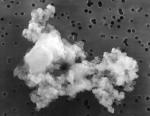 A Piece of Interplanetary Dust
13.08.2001
The dust that pervades our Solar System is not the dust that pervades our homes. Solar System dust comes from comets and asteroids, whereas house dust is most likely lint or dead cells. Pictured above is a piece of interplanetary dust caught by a high-flying U2-type aircraft.
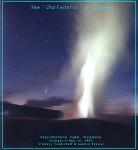 Old Faithful Meets Hale-Bopp
26.05.1997
As Comet Hale-Bopp leaves our Northern Skies, it provides us with yet another burst of joy. On May 11th the fading comet was photographed behind the famous "Old Faithful" water geyser of Yellowstone National Park, Wyoming, USA, Planet Earth.
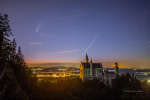 Fairytale NEOWISE
23.07.2020
Comet dust falls through a twilight sky in this dream-like scene, but it's not part of a fairytale movie. Still, Castle Neuschwanstein, nestled in the Bavarian Alps, did inspire Disneyland's Sleeping Beauty Castle. Captured on July 20, the bright streak above the castle towers is likely a Perseid meteor.
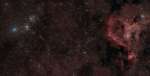 Clusters, Hartley, and the Heart
14.10.2010
An alluring Comet Hartley 2 cruised through planet Earth's night sky on October 8, passing within about a Full Moon's width of the famous double star cluster in Perseus. The much anticipated...
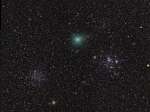 Hartley 2 Star Cluster Tour
2.12.2010
Early in November, small but active Comet Hartley 2 (103/P Hartley) became the fifth comet imaged close-up by a spacecraft from planet Earth. Continuing its own tour of the solar system with a 6 year orbital period, Hartley 2 is now appearing in the nautical constellation Puppis.
 APOD: 2023 August 23 Б The Meteor and the Galaxy
23.08.2023
It came from outer space. It -- in this case a sand-sized bit of a comet nucleus -- was likely ejected many years ago from Sun-orbiting Comet Swift-Tuttle, but then continued to orbit the Sun alone.
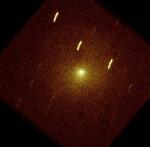 A Swift Look at Tempel 1
3.07.2005
Comet Tempel 1 is targeted for a collision with the impactor probe from NASA's Deep Impact Spacecraft at about 1:52am EDT on July 4th (other time zones). Cameras on the impactor probe...
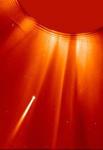 SOHO Sungrazer
1.09.2000
SOHO, the space-based SOlar and Heliospheric Observatory, has become by far the reigning champion facility for discovering comets, its total having recently reached 200. As might be expected of a solar observatory, most of the SOHO discovered comets are sungrazers, destined to dive within a mere 50 thousand kilometers or so of the solar photosphere.
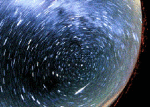 Leonid Meteor Shower Next Week
8.11.1998
Early next week, a spectacular meteor storm is expected: the 1998 Leonids. It is widely thought that that the meteors from the Leonids meteor shower are just small pieces of Comet Temple-Tuttle falling to Earth.
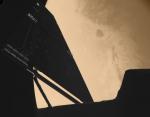 Rosetta Over Mars
1.03.2007
Panels on ESA's Rosetta spacecraft appear in the foreground of this intriguing image of Mars recorded on February 25 at a range of about 1,000 kilometers. Launched in March 2004, Rosetta...
|
January February March April May June July August September October |
|||||||||||||||||||||||||||||||||||||||||||||||||