
|
You entered: comet
 Perihelion Approaches
15.08.2015
This dramatic outburst from the nucleus of Comet 67P/Churyumov-Gerasimenko occured on August 12, just hours before perihelion, its closest approach to the Sun. Completing an orbit of the Sun once every 6.45 years, perihelion distance for this periodic comet is about 1.3 astronomical units (AU), still outside the orbit of planet Earth (at 1 AU).
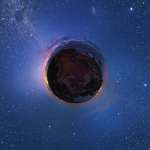 Little Planet Lovejoy
11.01.2012
Once a bright apparition in the southern hemisphere dawn Comet Lovejoy is fading, but its long tail still stretches across skies near the south celestial pole. Captured on the morning of December 30th, the comet appears near edge of this little planet as well.
 ISON, Mars, Regulus
17.10.2013
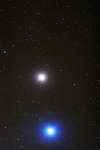
In order top to bottom this celestial snapshot features Comet ISON, planet Mars, and Regulus, alpha star of the constellation Leo, in the same frame. The scene spans about 2 degrees near the eastern horizon in early morning skies of October 15.
 Orionid Meteors from Orion
30.10.2017
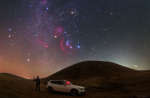
Meteors have been shooting out from the constellation of Orion. This was expected, as October is the time of year for the Orionids Meteor Shower. Pictured here, over a dozen meteors were caught in successively added exposures last weekend over Wulan Hada volcano in Inner Mongolia, China.
 A Dust Jet From Hale-Bopp
29.07.1996
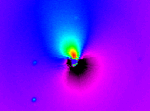
Approaching the inner Solar System, comet Hale-Bopp's icy nucleus is heated by sunlight, accelerating its production of dust and gas. Shrouded in the resulting cloud, known as the coma, the cometary nucleus remains hidden from direct view.
 Seven Years of Halley Dust
28.10.2022
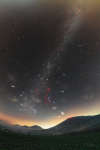
History's first known periodic comet Halley (1P/Halley) returns to the inner Solar System every 75 years or so. The famous comet made its last appearance to the naked-eye in 1986. But dusty debris...
 Animation: Perseid Meteor Shower
8.08.2018
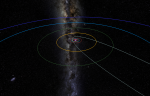
Where do Perseid meteors come from? Mostly small bits of stony grit, Perseid meteoroids were once expelled from Comet Swift-Tuttle and continue to follow this comet's orbit as they slowly disperse. The featured animation depicts the entire meteoroid stream as it orbits our Sun.
 APOD: 2026 May 14 Б The Messier Catalog at Uniform Scale
14.05.2026
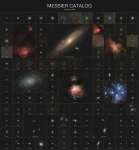
What are some of the most interesting astronomical objects you can see in the night sky? Armed with a good pair of binoculars or a small telescope, if you live in the Northern Hemisphere, you can look for the very popular objects in the Messier Catalog.
 3D 67P
30.03.2019
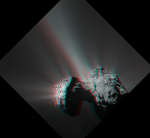
Put on your red/cyan glasses and float next to the jagged and double-lobed nucleus of Churyumov-Gerasimenko, also known as Comet 67P. The stereo anaglyph was created by combining two images from the Rosetta spacecraft's narrow angle OSIRIS camera taken on July 25, 2015 from a distance of 184 kilometers.
 Rosetta s Selfie
16.10.2014
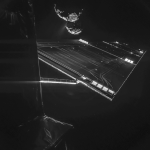
This Rosetta spacecraft selfie was snapped on October 7th. At the time the spacecraft was about 472 million kilometers from planet Earth, but only 16 kilometers from the surface of comet 67P/Churyumov-Gerasimenko. Looming beyond...
|
January February March April May June July August September October |
|||||||||||||||||||||||||||||||||||||||||||||||||