
|
You entered: comet
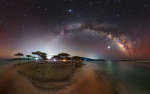 Light and Glory over Crete
16.11.2020
The month was July, the place was the Greek island of Crete, and the sky was spectacular. Of course there were the usual stars like Polaris, Vega, and Antares -- and that common asterism everyone knows: the Big Dipper. But this sky was just getting started.
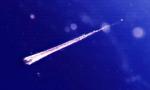 Catching Falling Stardust
1.02.1997
This carrot shaped track is actually little more than 5 hundredths of an inch long. It is the trail of a meteroid through aerogel exposed to space by the shuttle launched EURECA (European Recoverable Carrier) spacecraft.
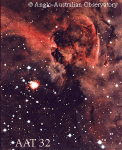 The Keyhole Nebula Near Eta Carinae
4.04.1996
The dark dusty Keyhole Nebula gets its name from its unusual shape. Designated NGC 3324, the Keyhole Nebula is a smaller region superposed on the bright Eta Carina Nebula. The Eta Carina Nebula...
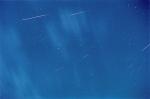 Meteors Between Stars and Clouds
11.12.2002
Streaking high above diffuse clouds -- but well in front of distant stars -- are sand-sized bits of an ancient comet: meteors. These bits flaked off Comet Tempel-Tuttle during its pass through the inner Solar System about 150 years ago. Far in the background are stars toward the constellation of Ursa Major.
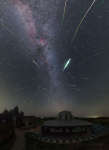 Perseid Meteors over Slovakia
12.08.2019
Tonight is a good night to see meteors. Comet dust will rain down on planet Earth, streaking through dark skies during the peak of the annual Perseid Meteor Shower. The featured composite image was taken during last year's Perseids from the Poloniny Dark Sky Park in Slovakia.
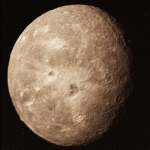 Uranus's Moon Oberon: Impact World
8.04.1996
Oberon is the most distant and second largest moon of Uranus. Discovered by William Herschel in 1787, the properties of the world remained relatively unknown until the robot spacecraft Voyager 2 passed it during its flyby of Uranus in January 1986.
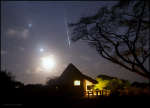 Kenya Morning Moon, Planets and Taurid
12.11.2015
On November 8, a waning crescent Moon joined the continuing parade of planets in Earth's morning skies. Captured here from Amboseli National Park, Kenya, even the overexposed moonlight can't washout brilliant Venus though, lined up near the ecliptic plane with faint Mars and bright Jupiter above.
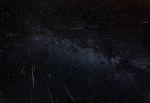 Raining Perseids
20.08.2004
Comet dust rained down on planet Earth last week, streaking through dark skies in the annual Perseid meteor shower. So, while enjoying the anticipated space weather, astronomer Fred Bruenjes recorded a series of many 30 second long exposures spanning about six hours on the night of August 11/12 using a wide angle lens.
 Three Perseid Nights
20.08.2021
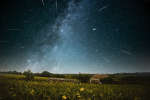
Frames from a camera that spent three moonless nights under the stars create this composite night skyscape. They were recorded during August 11-13 while planet Earth was sweeping through the dusty trail of comet Swift-Tuttle.
 Hubble View: Jupiter Impact
31.07.2009
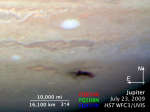
This sprawling dark marking is Jupiter's latest impact scar, a debris plume created as a small asteroid or comet disintegrated after plunging into the gas giant's atmosphere. Located in Jupiter's south polar region, the new feature was discovered by Australian amateur astronomer Anthony Wesley on July 19.
|
January February March April May June July August September October |
|||||||||||||||||||||||||||||||||||||||||||||||||