
|
You entered: launch
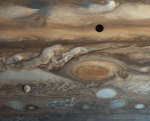 Europa and Jupiter from Voyager 1
5.09.2017
What are those spots on Jupiter? Largest and furthest, just right of center, is the Great Red Spot -- a huge storm system that has been raging on Jupiter possibly since Giovanni Cassini's likely notation of it 352 years ago. It is not yet known why this Great Spot is red.
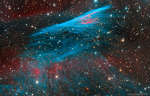 The Pencil Nebula in Red and Blue
13.08.2018
This shock wave plows through interstellar space at over 500,000 kilometers per hour. Near the top and moving up in this sharply detailed color composite, thin, bright, braided filaments are actually long ripples in a cosmic sheet of glowing gas seen almost edge-on.
 The Shadow of Ingenuity s Damaged Rotor Blade
10.02.2024
On January 18, 2024, during its 72nd flight in the thin Martian atmosphere, autonomous Mars Helicopter Ingenuity rose to an altitude of 12 meters (40 feet) and hovered for 4.5 seconds above the Red Planet. Ingenuity's 72nd landing was a rough one though.
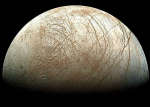 Gibbous Europa
15.12.2013
Although the phase of this moon might appear familiar, the moon itself might not. In fact, this gibbous phase shows part of Jupiter's moon Europa. The robot spacecraft Galileo captured this image mosaic during its mission orbiting Jupiter from 1995 - 2003.
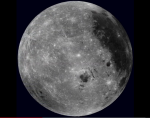 Rotating Moon from LRO
19.07.2020
No one, presently, sees the Moon rotate like this. That's because the Earth's moon is tidally locked to the Earth, showing us only one side. Given modern digital technology, however, combined with many detailed images returned by the Lunar Reconnaissance Orbiter (LRO), a high resolution virtual Moon rotation movie has been composed.
 Earthset from Orion
20.11.2024
Eight billion people are about to disappear in this snapshot from space taken on 2022 November 21. On the sixth day of the Artemis I mission, their home world is setting behind the Moon's bright edge as viewed by an external camera on the outbound Orion spacecraft.
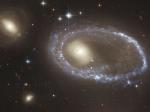 Ring Galaxy AM 0644 741 from Hubble
26.04.2004
How could a galaxy become shaped like a ring? The rim of the blue galaxy pictured on the right is an immense ring-like structure 150,000 light years in diameter composed of newly formed, extremely bright, massive stars.
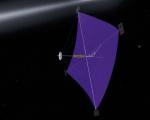 Solar Sail
21.08.2004
Could solar sailing become a future Olympic sport? Nearly 400 years ago astronomer Johannes Kepler observed comet tails blown by a solar breeze and suggested that vessels might likewise navigate through space using appropriately fashioned sails.
 The Crew 8 Nebula
7.03.2024
Not the James Webb Space Telescope's latest view of a distant galactic nebula, this cloud of gas and dust dazzled spacecoast skygazers on March 3. The telephoto snapshot was taken minutes after the launch of a Falcon 9 rocket on the SpaceX Crew-8 mission, to the International Space Station.
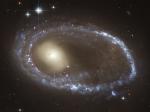 Ring Galaxy AM 0644 741 from Hubble
22.10.2005
How could a galaxy become shaped like a ring? The rim of the blue galaxy pictured on the right is an immense ring-like structure 150,000 light years in diameter composed of newly formed, extremely bright, massive stars.
|
January February March April May June July August September October |
|||||||||||||||||||||||||||||||||||||||||||||||||