
|
You entered: launch
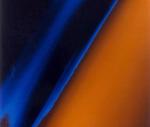 Voyager Views Titan s Haze
5.09.2002
Launched in 1977, 25 years ago today, the Voyager 1 spacecraft's historic tour of the outer Solar System took it past Saturn in late 1980. On November 12, 1980, Voyager 1 recorded this view looking across the edge of Titan, Saturn's largest moon, from a distance of about 22,000 kilometers.
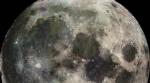 Lunar Prospects
18.09.1998
Launched on January 6th, NASA's Lunar Prospector spacecraft has been exploring the Moon with instruments designed to sense global properties while orbiting pole-to-pole, 63 miles above the lunar surface. Now over half...
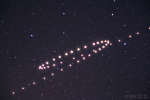 Mars in the Loop
9.08.2012
This composite of images spaced some 5 to 7 days apart from late October 2011 (top right) through early July 2012 (bottom left), traces the retrograde motion of ruddy-colored Mars through planet Earth's night sky.
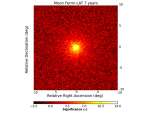 Fermi s Gamma-ray Moon
29.04.2016
If you could only see gamma-rays, photons with up to a billion or more times the energy of visible light, the Moon would be brighter than the Sun! That startling notion underlies this novel...
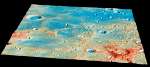 MESSENGER s Last Day on Mercury
1.05.2015
The first to orbit Mercury, the MESSENGER spacecraft came to rest on this region of Mercury's surface yesterday. Constructed from MESSENGER image and laser altimeter data, the scene looks north over the northeastern rim of the broad, lava filled Shakespeare basin.
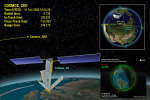 Satellites Collide in Low Earth Orbit
18.02.2009
How often do satellites collide? Although minuscule space debris may strike any satellite on occasion, the first known collision between time two full satellites occurred only last week. Even though thousands of satellites have been launched, the low collision rate is caused by the great vastness of space.
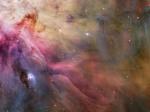 LL Ori and the Orion Nebula
20.01.2006
This esthetic close-up of cosmic clouds and stellar winds features LL Orionis, interacting with the Orion Nebula flow. Adrift in Orion's stellar nursery and still in its formative years, variable star LL Orionis produces a wind more energetic than the wind from our own middle-aged Sun.
 APOD: 2024 July 23 Б The Crab Nebula from Visible to X Ray
23.07.2024
What powers the Crab Nebula? A city-sized magnetized neutron star spinning around 30 times a second. Known as the Crab Pulsar, it is the bright spot in the center of the gaseous swirl at the nebula's core.
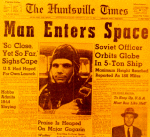 Man Enters Space
12.04.1996
Thirty five years ago today, Soviet cosmonaut Yuri Alexseyevich Gagarin became the first human in space. On April 12, 1961, his remotely controlled Vostok 1 spacecraft lofted him to an altitude of 200 miles and carried him once around planet Earth.
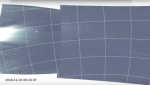 Looking Sideways from the Parker Solar Probe
9.12.2019
Everybody sees the Sun. Nobody's been there. Starting in 2018 though, NASA launched the robotic Parker Solar Probe (PSP) to investigate regions near to the Sun for the first time. The PSP's looping orbit brings it yet closer to the Sun each time around -- every few months.
|
January February March April May June July August September October |
|||||||||||||||||||||||||||||||||||||||||||||||||