
|
You entered: nearby
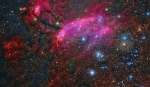 IC 4628: The Prawn Nebula
8.12.2016
South of Antares, in the tail of the nebula-rich constellation Scorpius, lies emission nebula IC 4628. Nearby hot, massive stars, millions of years young, irradiate the nebula with invisible ultraviolet light, stripping electrons from atoms. The electrons eventually recombine with the atoms to produce the visible nebular glow, dominated by the red emission of hydrogen.
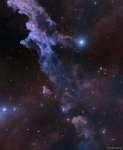 The Witch Head Nebula
30.12.2018
Double, double toil and trouble; Fire burn, and cauldron bubble .... maybe Macbeth should have consulted the Witch Head Nebula. A frighteningly shaped reflection nebula, this cosmic crone is about 800 light-years away though. Its malevolent visage seems to glare toward nearby bright star Rigel in Orion, just off the right edge of this frame.
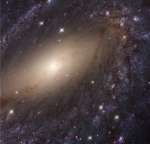 NGC 6744: Extragalactic Close Up
24.11.2022
Beautiful spiral galaxy NGC 6744 is nearly 175,000 light-years across. That's larger than the Milky Way. It lies some 30 million light-years distant in the southern constellation Pavo, with its galactic disk tilted towards our line of sight.
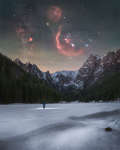 APOD: 2026 January 27 Б Orions Treasures over Snowy Mountains
26.01.2026
Rising over a frozen valley in the Tatra Mountains, the familiar stars and nebulas of Orion dominate this wide-field nightscape. The featured deep photo was taken in southern Poland's highest mountain range last month, where dark skies and alpine terrain combined to reveal both Earth's rugged beauty and the structure of our galaxy.
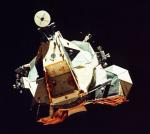 Apollo 17's Moonship
5.01.2001
Awkward and angular looking, Apollo 17's lunar module Challenger was designed for flight in the vacuum of space. This sharp picture from the command module America, shows Challenger's ascent stage in lunar orbit.
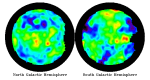 COBE Hotspots:The Oldest Structures Known
8.03.1997
Above are two images of the microwave sky, north and south of our galaxy's equator, based on data from NASA's COsmic Background Explorer (COBE) satellite. After computer processing to remove contributions from nearby objects and the effects of the earth's motion, they show "spots".
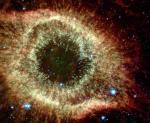 Infrared Helix
11.01.2006
Over six hundred light years from Earth, in the constellation Aquarius, a sun-like star is dying. Its last few thousand years have produced the Helix Nebula (NGC 7293), a well studied and nearby example of a Planetary Nebula, typical of this final phase of stellar evolution.
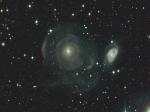 Galaxy NGC 474: Cosmic Blender
8.10.2007
What's happening to galaxy NGC 474? The multiple layers of emission appear strangely complex and unexpected given the relatively featureless appearance of the elliptical galaxy in less deep images. The cause...
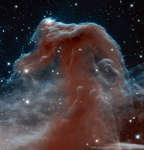 The Horsehead Nebula in Infrared from Hubble
11.04.2020
While drifting through the cosmos, a magnificent interstellar dust cloud became sculpted by stellar winds and radiation to assume a recognizable shape. Fittingly named the Horsehead Nebula, it is embedded in the vast and complex Orion Nebula (M42).
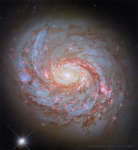 APOD: 2025 December 2 Б M77: Spiral Galaxy with an Active Center
1.12.2025
What's happening in the center of nearby spiral galaxy M77? The face-on galaxy lies a mere 47 million light-years away toward the constellation of the Sea Monster (Cetus). At that estimated distance, this gorgeous island universe is about 100 thousand light-years across.
|
January February March April May June July August |
||||||||||||||||||||||||||||||||||||||||||||||||||||||||