
|
You entered: nearby
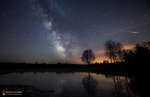 Halley Dust and Milky Way
9.05.2014
The early morning hours of May 6 were moonless when grains of cosmic dust streaked through dark skies. Swept up as planet Earth plows through dusty debris streams left behind periodic Comet Halley, the annual meteor shower is known as the Eta Aquarids.
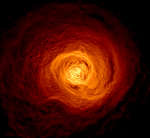 The Perseus Cluster Waves
4.05.2017
The cosmic swirl and slosh of giant waves in an enormous reservoir of glowing hot gas are traced in this enhanced X-ray image from the Chandra Observatory. The frame spans over 1 million light-years across the center of the nearby Perseus Galaxy Cluster, some 240 million light-years distant.
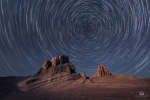 Star Trails for a Red Planet
30.11.2019
Does Mars have a north star? In long exposures of Earth's night sky, star trails make concentric arcs around the north celestial pole, the direction of our fair planet's axis of rotation. Bright star Polaris is presently the Earth's North Star, close on the sky to Earth's north celestial pole.
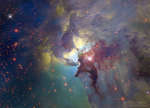 The Lively Center of the Lagoon Nebula
25.05.2022
The center of the Lagoon Nebula is a whirlwind of spectacular star formation. Visible near the image center, at least two long funnel-shaped clouds, each roughly half a light-year long, have been formed by extreme stellar winds and intense energetic starlight. A tremendously bright nearby star, Herschel 36, lights the area.
 APOD: 2025 August 19 Б Giant Galaxies in Pavo
19.08.2025
Over 500,000 light years across, NGC 6872 (bottom left) is a truly enormous barred spiral galaxy. At least 5 times the size of our own large Milky Way, NGC 6872 is the largest known spiral galaxy.
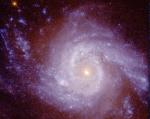 Spiral Galaxy NGC 3310 in Ultraviolet
17.01.2001
Why is NGC 3310 bursting with young stars? The brightest of these new stars are so hot that they light up this spiral galaxy not only in blue light, but in light so blue humans can't see it: ultraviolet. The Hubble Space Telescope took the above photograph in different bands of ultraviolet light.
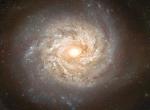 Spiral Galaxy NGC 3982 Before Supernova
3.11.2003
What do stars look like just before they explode? To find out, astronomers are taking detailed images of nearby galaxies now, before any supernova is visible. Hopefully, a star in one of the hundreds of high resolution galaxy images will explode in the coming years.
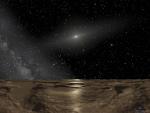 Sedna at Noon
4.06.2004
Standing on Sedna - the solar system's most distant known planetoid - your view of the Sun at high noon might look something like this. An artist's dramatic vision, the picture shows the Sun suspended above the nearby horizon as a bright star immersed in the dusty ecliptic plane.
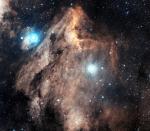 A Pelican in the Swan
30.11.2006
The Pelican Nebula lies about 2,000 light-years away in the high flying constellation Cygnus, the Swan. Also known as IC 5070, this cosmic pelican is appropriately found just off the "east coast" of the North America Nebula (NGC 7000), another surprisingly familiar looking emission nebula in Cygnus.
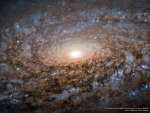 In the Center of Spiral Galaxy NGC 3521
30.11.2015
This huge swirling mass of stars, gas, and dust occurs near the center of a nearby spiral galaxy. Gorgeous spiral NGC 3521 is a mere 35 million light-years distant, toward the constellation Leo. Spanning some 50,000 light-years, its central region is shown in this dramatic image, constructed from data from the Hubble Space Telescope.
|
January February March April May June July August |
||||||||||||||||||||||||||||||||||||||||||||||||||||||||